


![[Expert Explains] What are CEFR Levels? Don't worry about comparing your child's English ability with others!](https://en.nisai-british-onlineschool.com/wp/wp-content/uploads/2026/01/cefr-english-levels.png)
- cefr
- 2026.1.16
[Expert Explains] What are CEFR Levels? Don’t worry about comparing your child’s English ability with others!
Why the CEFR now?importantBefore you start comparing yourself to others, here’s an objective measure of your English ability
Do you feel anxious, thinking, “The kids around me are fluent in English, but my child…”? Many parents say that even though they send their children to English conversation classes, it’s hard to know whether their children are really improving. The CEFR is a global benchmark that can help alleviate this vague anxiety and objectively assess your child’s English proficiency. Here, we’ll explain why knowing the CEFR now is essential for choosing the best English education for your child.
“Is my child’s English ability improving?” This is a question many parents have about English conversation classes.

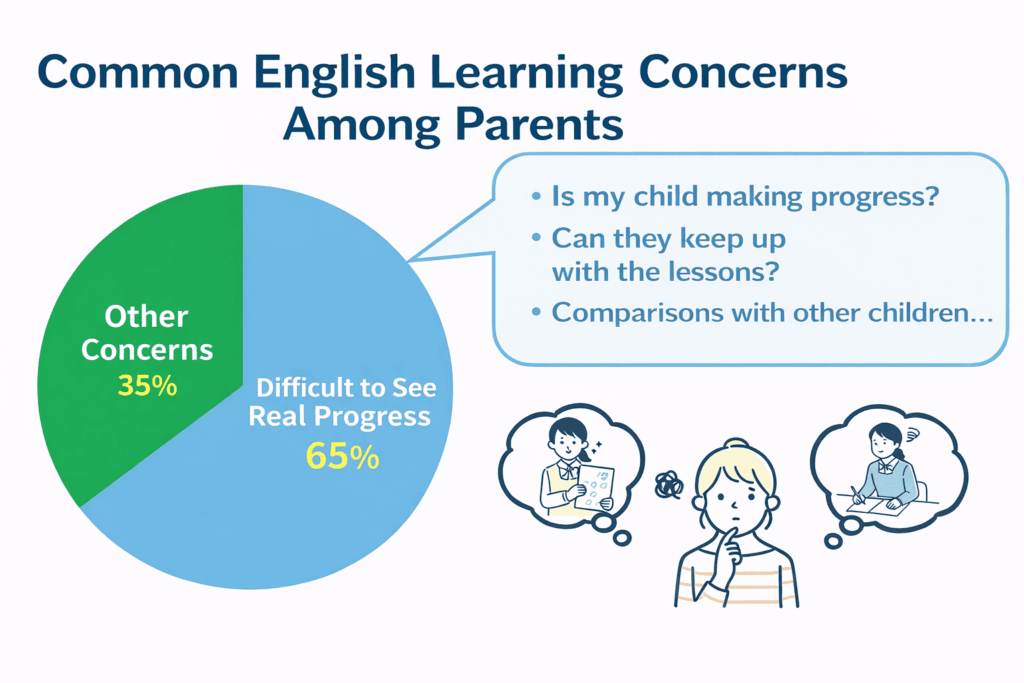
“My child seems to enjoy going to English classes every week, but what exactly is he learning?” This is a question many parents have about English conversation classes. Of course, there are major benefits, such as becoming familiar with English and getting used to having a foreign teacher. However, the reality is that it’s difficult to see concrete progress with just one lesson per week. Especially when the lesson content is activity-based, it’s easy to get a vague sense of what your child has learned in English, with only the impression that “it was fun.”
This “difficulty in seeing results” is the root cause of anxiety and impatience among parents. Since you are investing your child’s precious time and educational expenses, it is natural that you want to objectively understand the results and move on to the next step.
My mom friend’s child is fluent… The global standard “CEFR” will help you to resolve your vague anxiety
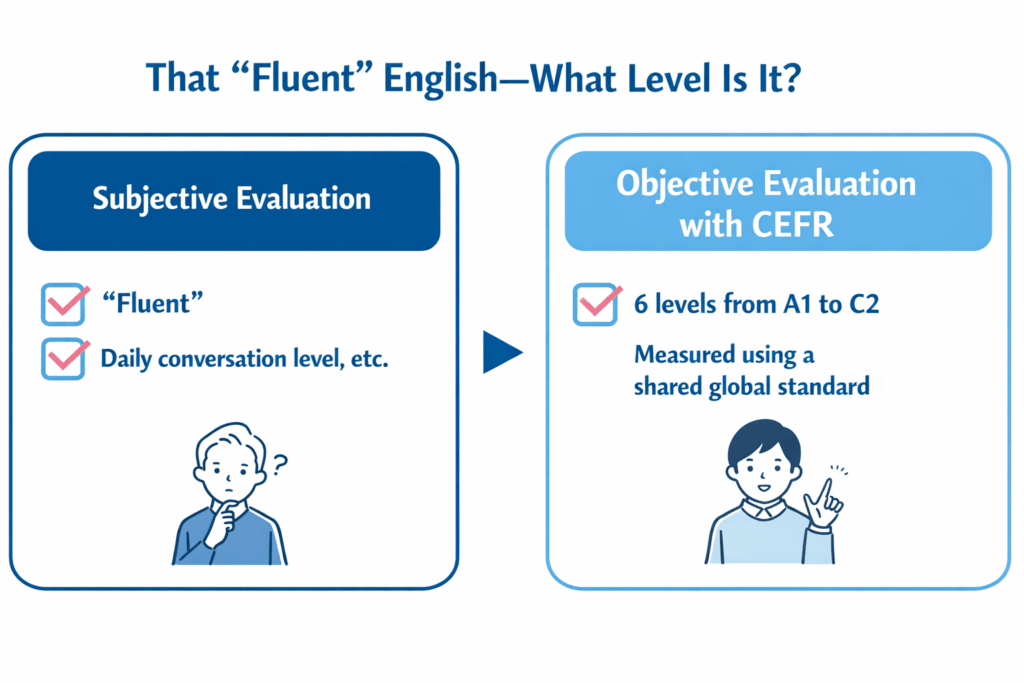
When you see other mom friends talking with their children and seeing them speak English fluently, you might start to worry, thinking, “Maybe my child is behind.” However, without an objective standard to determine what level “fluent” actually is, it’s impossible to make a proper comparison.
This is where the CEFR, a globally accepted language proficiency index, can come in handy. The CEFR clearly indicates “what specific things you can do in English” on a six-level scale, from A1 to C2. For example, you can use a common yardstick to measure whether your child is at the level where they can “introduce themselves” or “be able to state their opinion logically.” By knowing this objective standard, you can accurately grasp their current position and set goals for them, rather than getting excited or upset by comparing them with other children.
The need to accurately measure children’s English proficiency using the CEFR, regardless of age or grade level
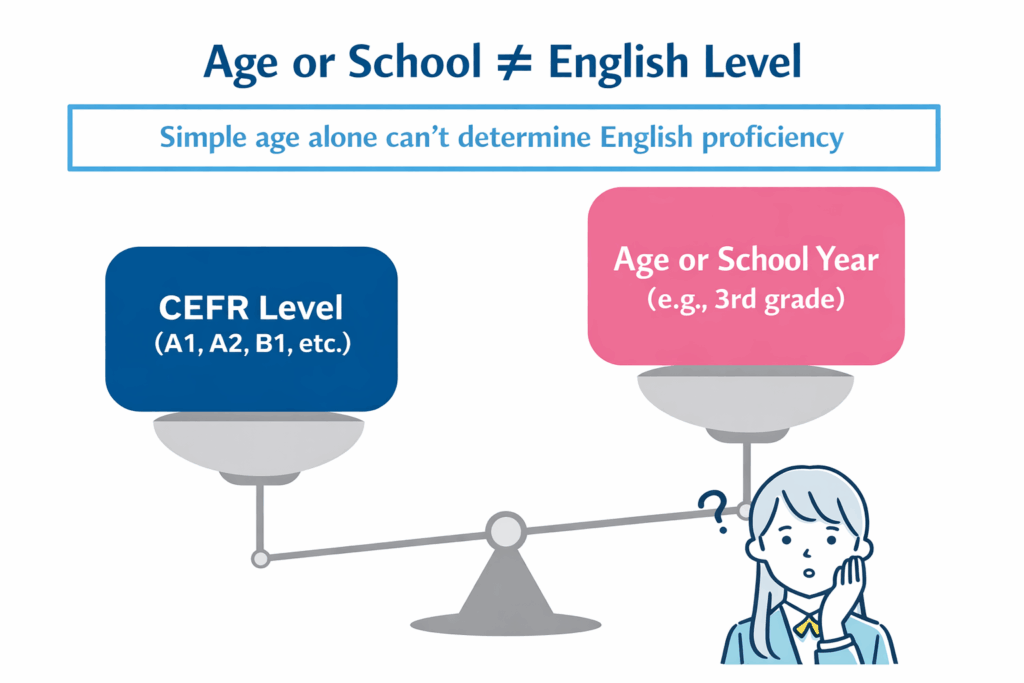
We tend to judge a child’s English ability based on age or grade level, such as “Because he’s in the third grade of elementary school, he should be able to do this much on the EIKEN® test.” However, the speed at which each child acquires a language varies greatly. In particular, in today’s world, where opportunities to be exposed to English in a variety of environments, such as children returning from overseas or attending international schools, have increased, it is not possible to accurately evaluate a child’s ability based solely on age.
The CEFR evaluates pure operational ability, or “what you can do now using the language,” regardless of age or learning experience. For this reason, it is entirely possible that an elementary school student who has been exposed to English since childhood will have a higher CEFR level than a high school student who has just started learning. Accurately understanding your child’s “current position,” regardless of age or grade level, is the first step to developing their English ability naturally and effectively.
What is the average English level of Japanese people? Understanding the current CEFR level compared to the rest of the world
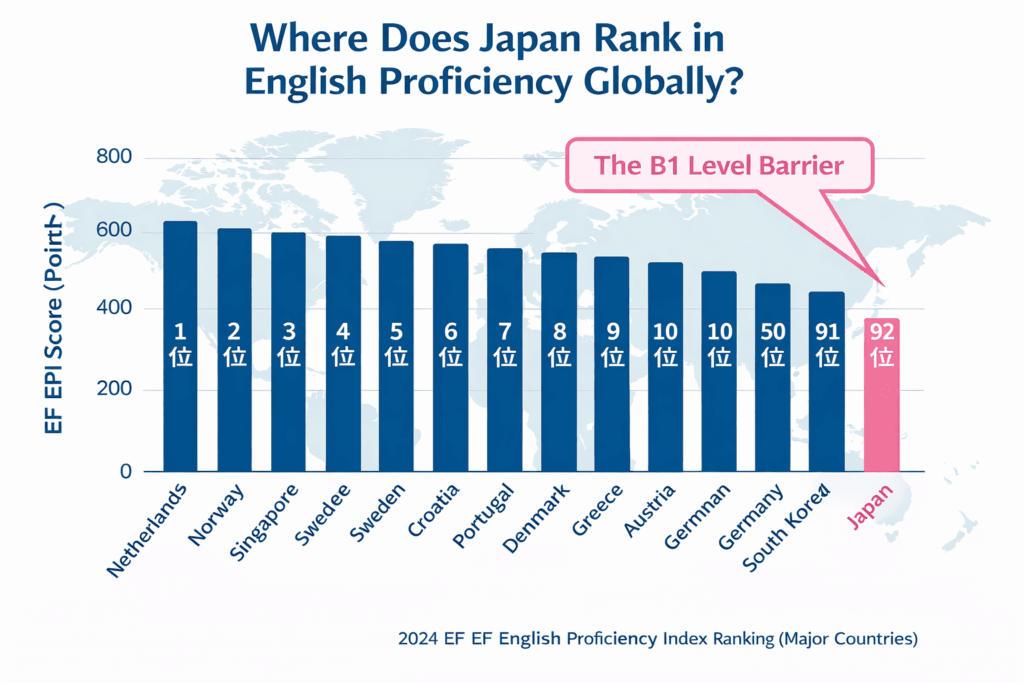
When considering your child’s English education, knowing where Japan’s overall English proficiency ranks globally can be helpful in setting goals. According to the international English Proficiency Index (EF EPI), Japan’s English proficiency has long been rated as “low” or “average,” and the percentage of learners who have reached the B1 level on the CEFR scale tends to be lower than in other developed countries. This suggests that even after six years of English study in junior high and high school, it is often difficult for students to reach the B level, which is considered “the ability to use the language independently.”
The reasons for this include a school education that focuses on reading and writing, and a lack of opportunities for practical communication. By being aware of the global standard, CEFR, you can think about your child’s education from a higher perspective, not just being satisfied within the framework of Japanese education, but cultivating genuine communication skills that can be used on a global stage.
[Explanation with a Table] What is CEFR? Let’s get a concrete understanding of your child’s English level
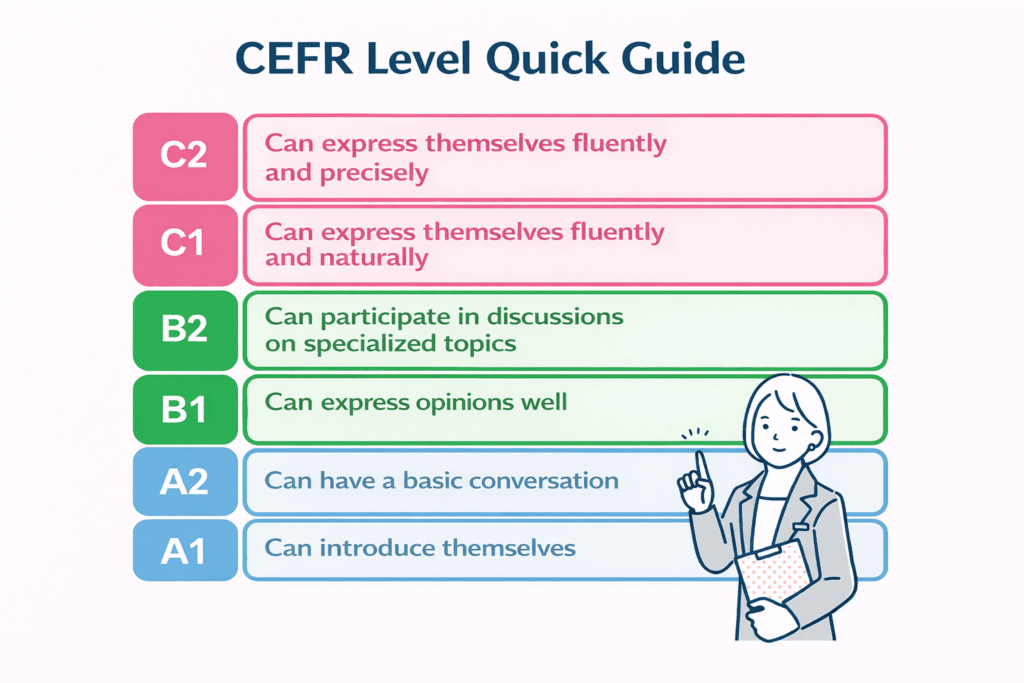
Even if you are familiar with the term CEFR, many people may not know the specific levels. Here, we will explain in an easy-to-understand list what you can specifically do at each level, from A1 to C2. We will also introduce which CEFR levels qualify for qualification exams familiar to parents, such as Eiken® and TOEIC®.MasuLet’s get a concrete idea of what stage your child’s English ability is at right now.
CEFR Level List: A clear explanation of what you can do from A1 to C2
The CEFR divides English proficiency into three major levels (A for foundation, B for independence, and C for proficiency), which are then further subdivided into six levels: A1, A2, B1, B2, C1, and C2. Let’s take a closer look at what you can do at each level.
A1 (Beginner): I can do a very simple self-introduction and greeting, and I can answer basic questions if you speak slowly and clearly.
A2 (Beginner): You can exchange simple information about familiar topics (family, shopping, work, etc.).
B1 (Intermediate): You can understand the main points of familiar topics, express your own opinions and experiences, and deal with most situations you may encounter while traveling.
B2 (Upper Intermediate Level): You can understand the main points of complex texts, including technical discussions in your field of expertise. You are at a level where you can interact naturally with native speakers.
C1 (Superior): Ability to understand a wide range of advanced content and express oneself fluently and naturally.
C2 (Top Level): You can easily understand almost everything you hear or read and express it very fluently and accurately.
[CEFR Conversion Table] What level is it in Eiken® or TOEIC®? Estimates for B2 and A2
![[CEFR Conversion Table] What level is it in Eiken® or TOEIC®? Estimates for B2 and A2](https://en.nisai-british-onlineschool.com/wp/wp-content/uploads/2026/01/cefr-eiken-toeic-2-1024x683.png)
The CEFR is merely an indicator of “what you can do using a language” and is not directly linked to a specific test, but you can get a rough idea by referring to conversion tables published by the Ministry of Education, Culture, Sports, Science and Technology and other organizations.
For example,A2 levelThis corresponds to the level of pre-2nd grade to 2nd grade in the EIKEN® test. This is the level where you can have simple conversations about everyday matters.B1 levelThe standard ranges from Eiken® Grade 2 to Grade Pre-1, and is around 550 to 780 points on the TOEIC® L&R. It is often required for those who want to enter a university abroad or use English fluently in business.B2 levelFor example, a score of around 785 to 940 on the Eiken® Pre-1st Grade to 1st Grade, or 785 to 940 on the TOEIC® L&R, is a good guideline. By using the CEFR as a base, it is possible to look at the results of different tests across the board and evaluate your child’s English ability from multiple angles.
What level should elementary and junior high school students achieve? Age-specific goals based on the CEFR
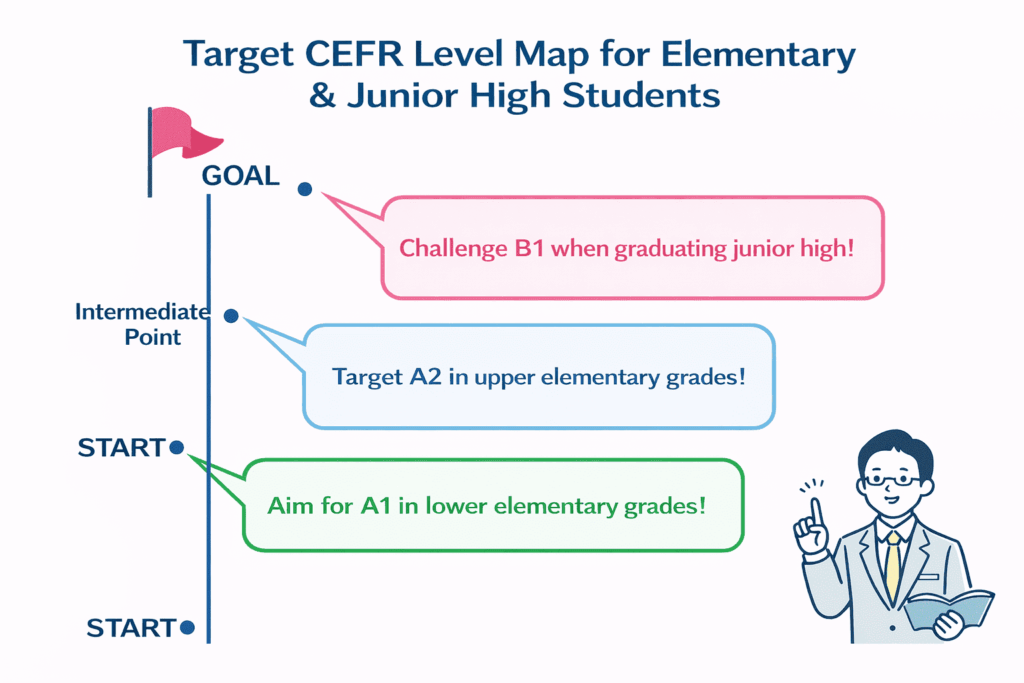
Setting specific goals is crucial for maintaining your child’s motivation to learn English. Consider age-specific goals based on the CEFR.Middle to upper grades of elementary schoolSo, firstA1 levelMake sure to clear theA2 levelIt is a good idea to set a goal of reaching this level. This is the level where you can give a simple self-introduction and ask and answer questions about familiar things. At this stage, it is important to develop basic English skills through phonics, which teaches the relationship between English sounds and letters, and by reading simple picture books.
junior high school studentsAt this age, school classes begin in earnest.B1 levelIt has been reachedDesirable goals andYes, you can. B1 is the level where you can express your opinion on familiar topics and participate in simple discussions. If you can reach this level, you will be able to smoothly transition into high school studies and future study abroad.
“What level is Eiken Grade 2?” Accurately compare familiar qualifications with your child’s English ability
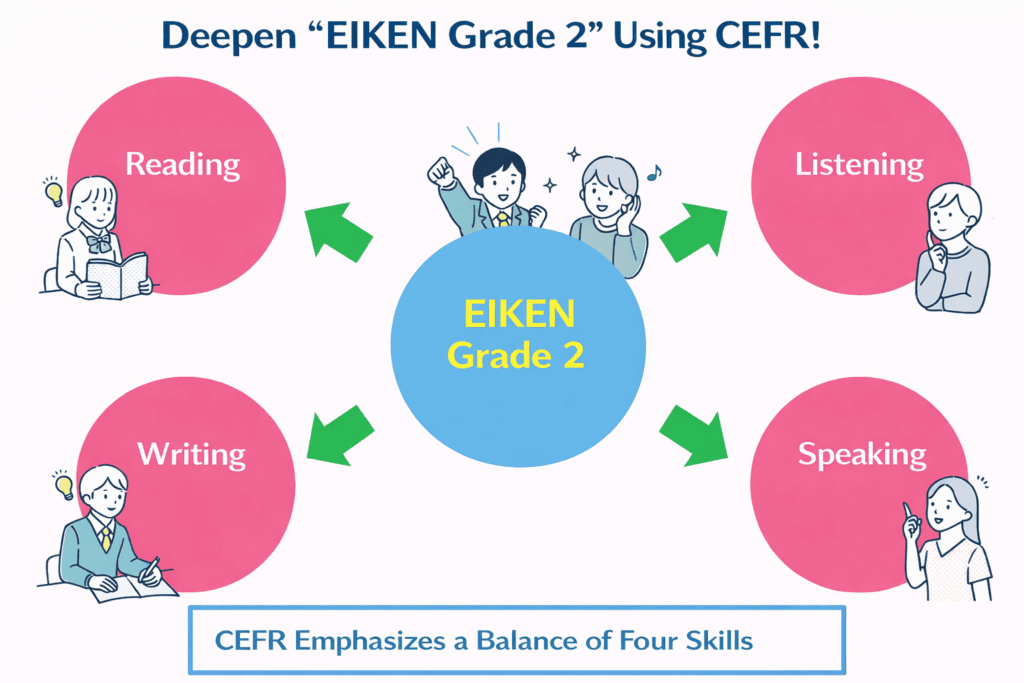
Many families are probably thinking, “Let’s aim for Eiken® Grade 2 for now.” Eiken Grade 2 is roughly equivalent to the B1 level in the CEFR. However, it’s important to note that passing Eiken® Grade 2 does not necessarily mean that a child has reached the B1 level in all four language skills.
Due to the nature of English education in Japan, it is common for children to achieve high scores in reading and listening, but their speaking and writing skills do not keep up. The CEFR places emphasis on the balance of these four skills. Therefore, in order to properly assess your child’s English ability, it is extremely important not only to “pass the Eiken® Grade 2” but also to understand their strengths and weaknesses in each skill and create a study plan to fill in any gaps.
Why is the CEFR important in international schools?
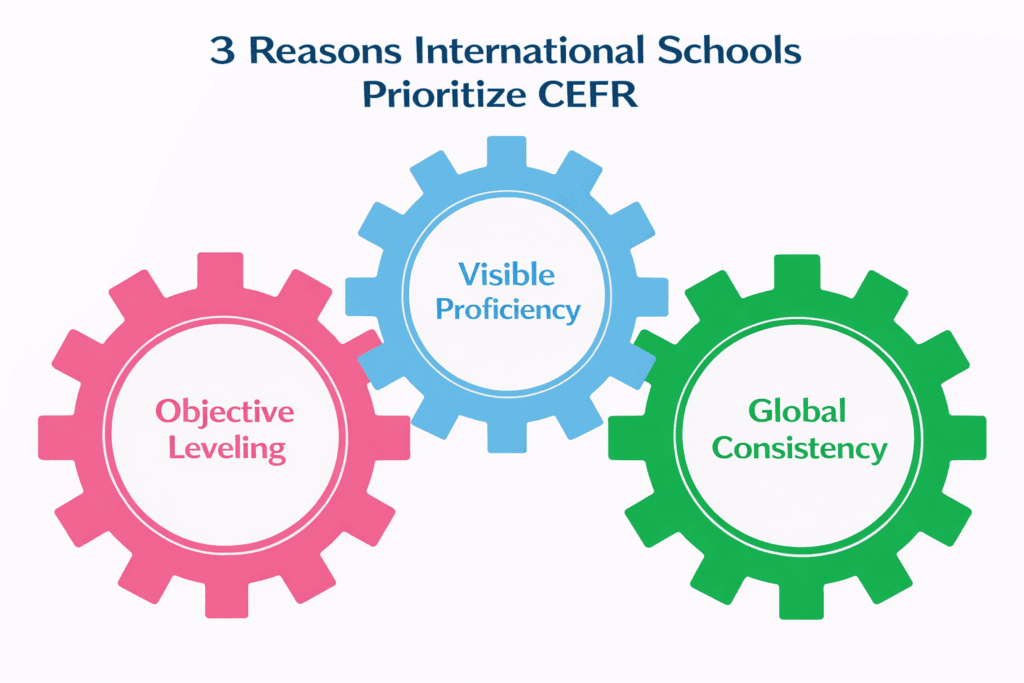
International schools and overseas educational institutions widely use the CEFR as the standard for measuring the English proficiency of prospective students for three main reasons.
First,Able to objectively evaluate students of diverse nationalitiesIn an environment where students come from all over the world, their backgrounds in learning English vary depending on their country of origin. By using the CEFR as a common benchmark, instructors can accurately assess each student’s English ability and provide appropriate class placement and instruction.
Secondly,High compatibility with educational curriculumThe CEFR assesses operational ability (Can-Do), or “what you can do with a language,” so it is well suited to the educational policies of international schools, which emphasize practical skills such as discussion and presentation, rather than just memorizing knowledge.
Lastly,it serves as a guide for those wishing to enter higher education.This is because overseas universities often require proof of specific English proficiency, such as CEFR B2 or above, when applying, and this serves as a consistent indicator.
How to choose the best English education environment for your child based on the CEFR
Once you have clarified your child’s current CEFR level and goals, the next step is to choose the best educational environment to help them achieve those goals. There are a variety of options, from general English conversation classes to full-fledged international schools. It is important to properly understand the advantages and disadvantages of each option and compare factors such as tuition fees and curriculum content. Here, we will explain the key points to consider when using the objective standard of the CEFR to find an environment that truly suits each child’s personality and goals.
The benefits of regular English conversation classes and their limitations when viewed through the CEFR
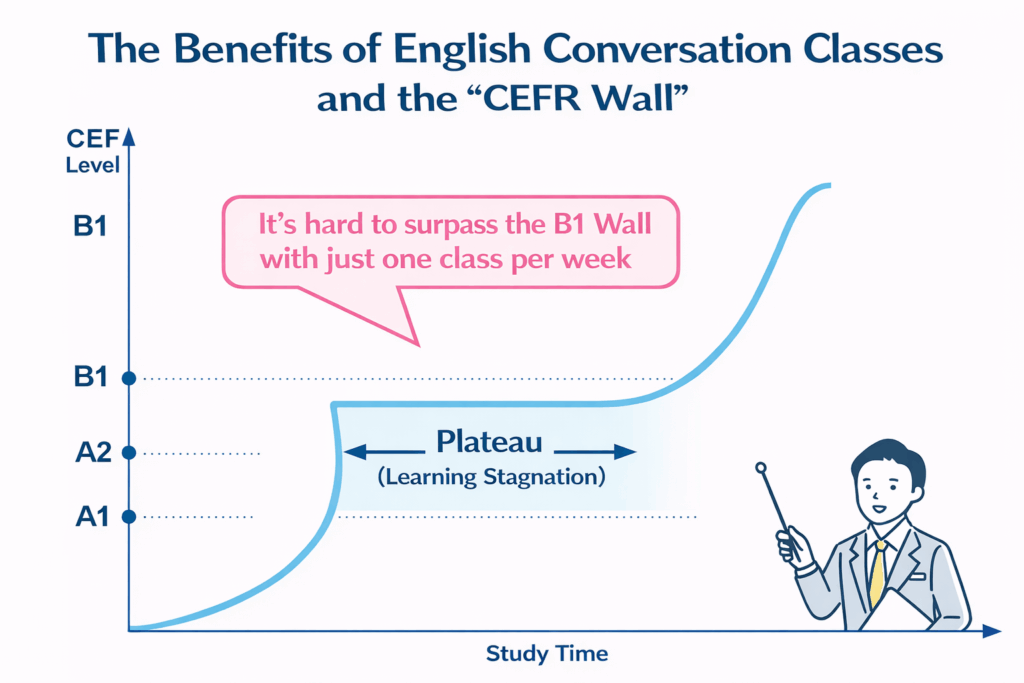
The biggest advantage of a typical English conversation school is that it’s easy to attend and provides an opportunity to have fun learning English. By communicating with native English teachers through games and songs, you can eliminate resistance to English and stimulate motivation to learn. In terms of the CEFR, it’s a very effective option for building a foundation for A1 to A2 levels.
However, there is also a limit. This is the stage where students aim for B1 level or above, that is, the level where they can “use the language independently.” Lessons that meet once a week for about an hour tend to provide insufficient time for exposure to English. Furthermore, if the curriculum is conversation-centered and there are few opportunities to cover advanced topics that require systematic reading and writing or logical thinking, this can lead to stagnation in progress in the CEFR level. If you want your child to reach B1 or above, you may need to consider an environment that guarantees more quantity and quality of input and output.
A thorough comparison of the advantages and disadvantages of sending your child to an international school
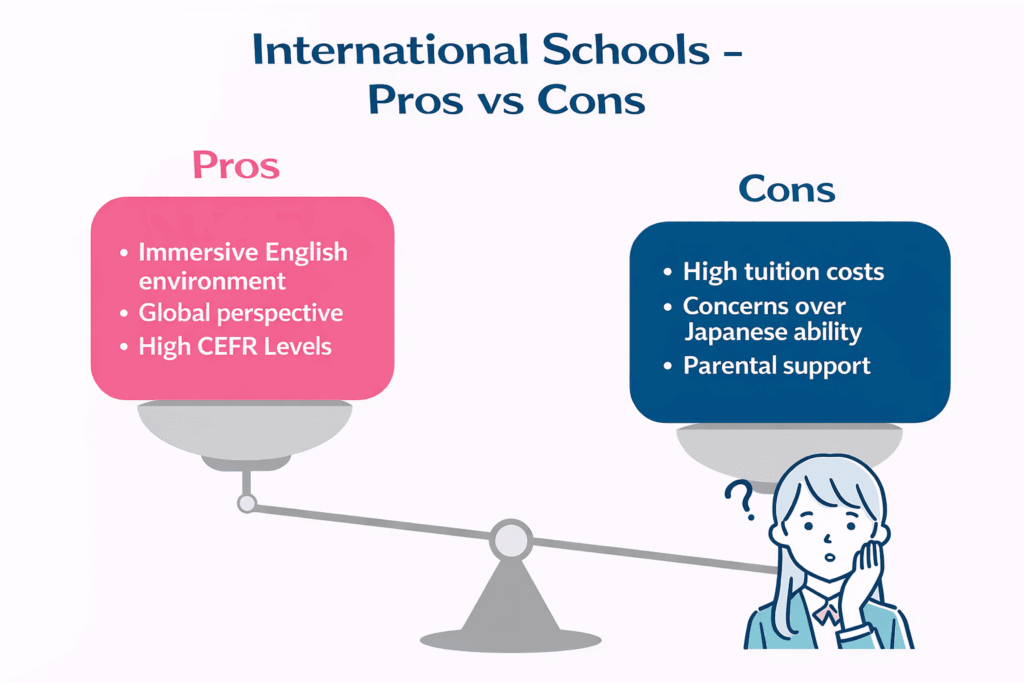
International schools are an extremely attractive option for dramatically improving your child’s English skills. The biggest benefit is the “immersion” environment, where classes and everyday conversations are all conducted in English. Because it becomes natural for children to “use” English rather than “study” it, their CEFR level improves naturally and rapidly. Another major attraction is that learning alongside children from diverse cultural backgrounds fosters an international perspective and an attitude of accepting diversity.
On the other hand, you should also carefully consider the disadvantages. The biggest hurdle is the high tuition fees.ProbablyIt is not uncommon for costs to exceed 2 million yen per year. Furthermore, if conversations at home are primarily in Japanese, there is concern that children’s Japanese vocabulary and thinking skills may not be fully developed, and parents may also be required to have a reasonable level of English proficiency for parent-teacher meetings and interviews, which can be a burden. It is essential to comprehensively assess the pros and cons of these options.
It’s not just about tuition fees: 3 things to check to avoid regrets when choosing a school
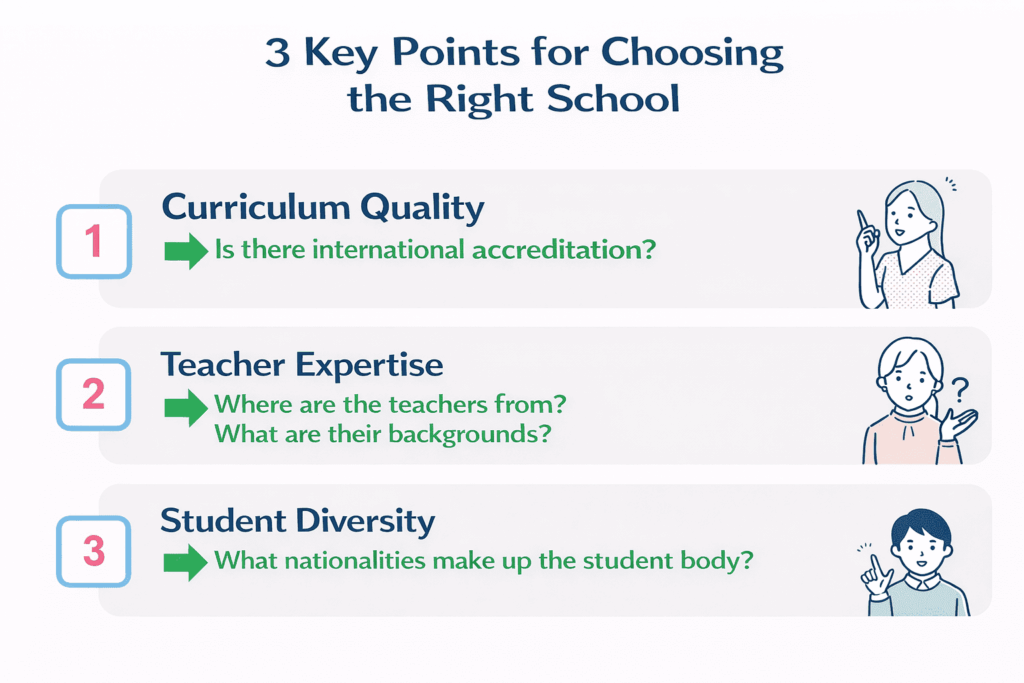
When choosing an international school or similar educational institution, it’s easy to focus on tuition fees, but what really matters is the quality of the education. Here are three things you should check to avoid any regrets.
1. International Curriculum Accreditation: Check whether the school is accredited with a globally recognised educational curriculum such as Cambridge International or the International Baccalaureate (IB), as this is an important indicator of educational quality.
2. Quality and expertise of faculty:It is important that the teachers are not just native English speakers, but also have teaching qualifications and ample teaching experience. Having teachers from a variety of countries also helps students to be exposed to a variety of English.
3. Student nationalities and diversity: If the student population is biased towards a particular culture, the environment may become biased towards a particular culture. Ensuring that students have diverse backgrounds is also an important point in fostering a global perspective.
The key to success is choosing an environment that suits your child’s personality and current CEFR level

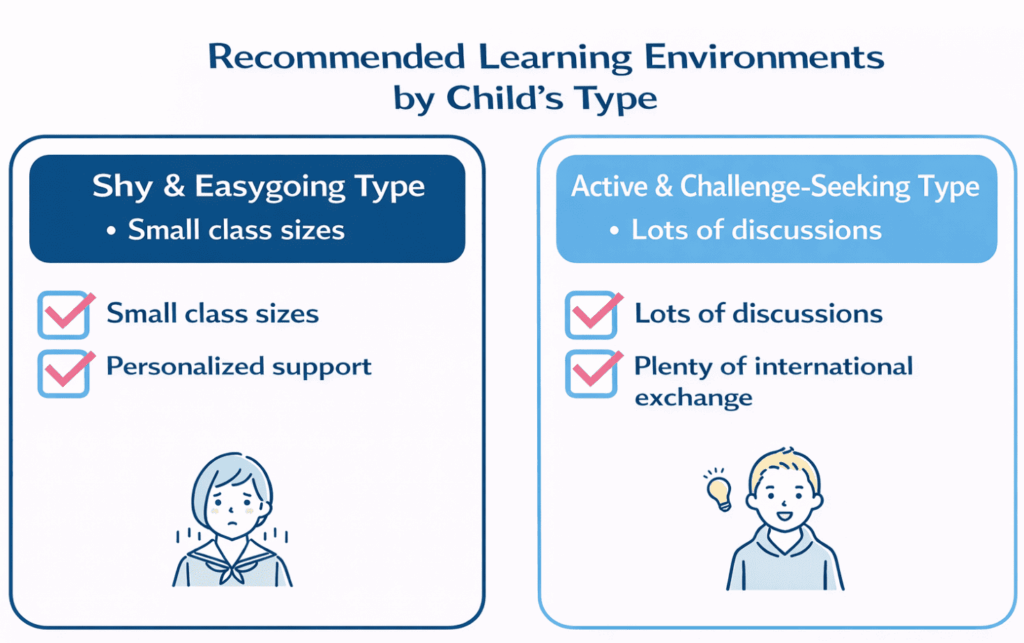
No matter how excellent an educational environment is, if it does not suit your child’s personality or current developmental stage, its effectiveness will be halved. For example, if a child is shy and prefers to learn at their own pace, suddenly placing them in a large, discussion-based class may make them feel intimidated and may even instill in them a sense of inferiority about English. For such children, a small-class environment where teachers can pay individual attention to each child, or online learning where they can proceed at their own pace, may be more suitable.
On the other hand, if your child is fearless and likes to communicate proactively, an environment where they can interact with a diverse range of students will be stimulating. The quickest way to success is to calmly analyze your child’s personality, along with their current CEFR level, and choose an environment that will best develop their abilities.
The third option: new possibilities for online international schools
While attending a regular international school is appealing, cost and location issues make it impractical… Parents who feel this way should definitely consider the option of “online international schools.” Advances in technology have made it possible for children to connect with students and teachers from around the world and receive a high-quality international education without leaving Japan. Here, we’ll take a closer look at the specific benefits and how they differ from traditional learning methods.
A world-class education from home: The difference between online and in-person education
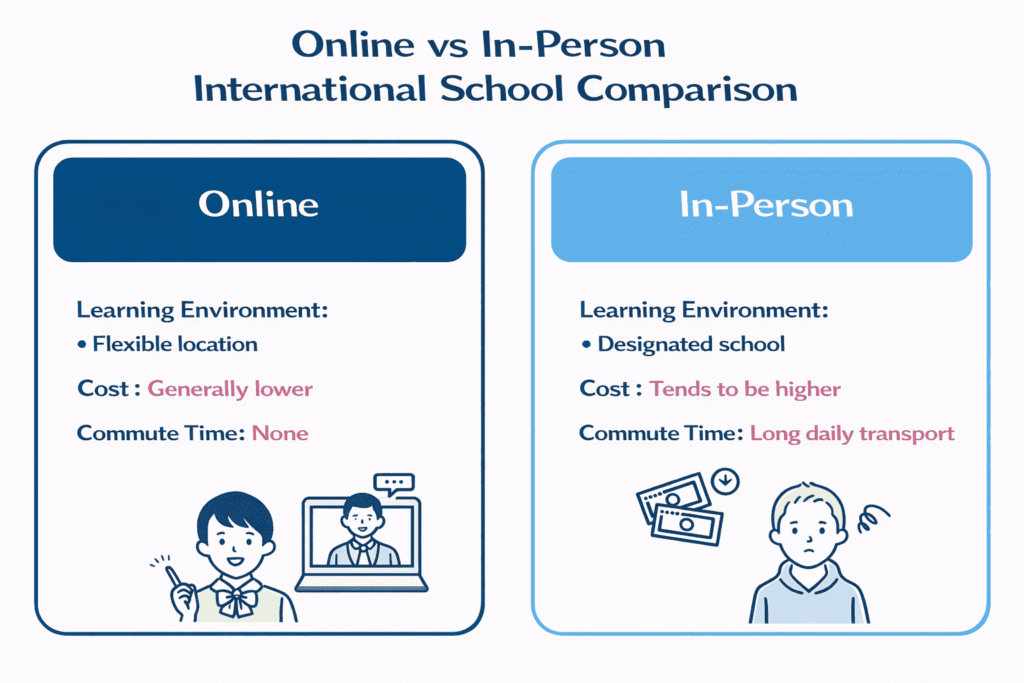
The biggest difference between online international schools and on-campus schools is, of course, the “place of study.” With online schools, as long as you have an internet connection, even those living in rural areas can access the same level of education as they would if they were overseas. This significantly reduces the physical burden of expensive tuition fees, moving, and long commutes to and from school.
There are also differences in learning styles. While in-person classes are based on learning in groups according to a set timetable, online classes allow for more flexible learning by combining live lessons with recorded lessons. Students can study at their own pace, even on days when they are not feeling well or have other commitments. On the other hand, online classes also have the drawback of requiring self-management skills and less physical interaction with friends, but an increasing number of schools are offering support systems to compensate for this.
The appeal of a global learning environment where students can learn together from around the world
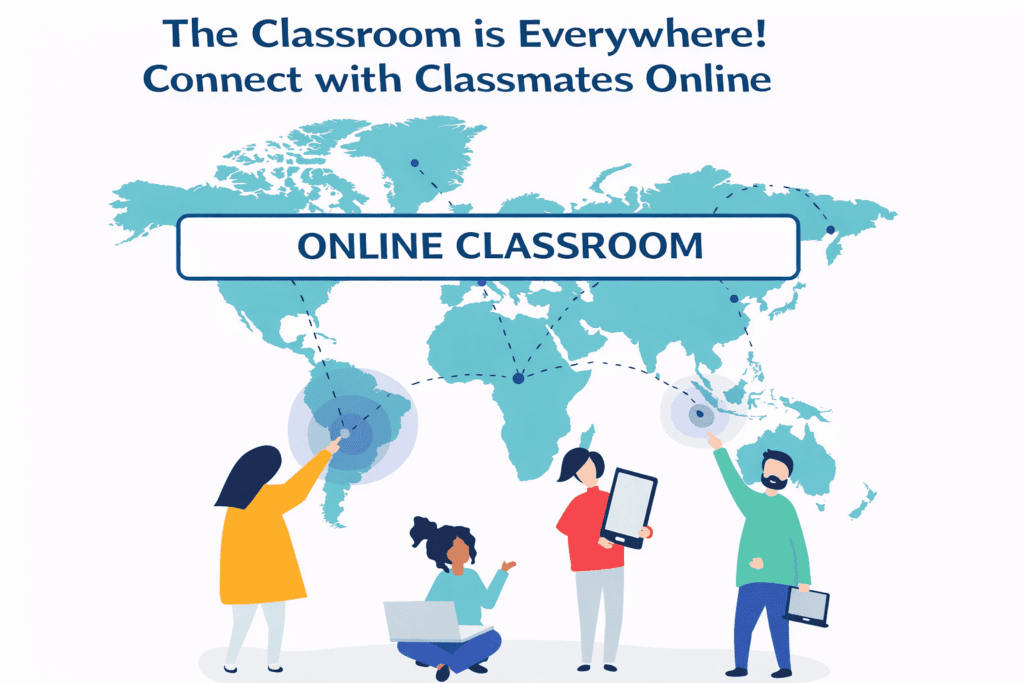
You may be concerned that online learning will limit interactions with other students. However, today’s online international schools offer a variety of innovative solutions to address this concern. For example, classes offer ample opportunities for students to break into small groups for discussions and collaborate on projects. Students are not only from within Japan, but also from all over the world, including Asia, the Middle East, and Europe.
The experience of discussing a single topic in English with classmates from completely different cultures and values will greatly broaden your child’s perspective and foster a foundation for accepting diversity. This will not only help them learn to speak English, but will also be an invaluable experience in developing the communication and critical thinking skills essential for surviving in a global society.
The benefits of delivering high-quality education beyond the constraints of time and place
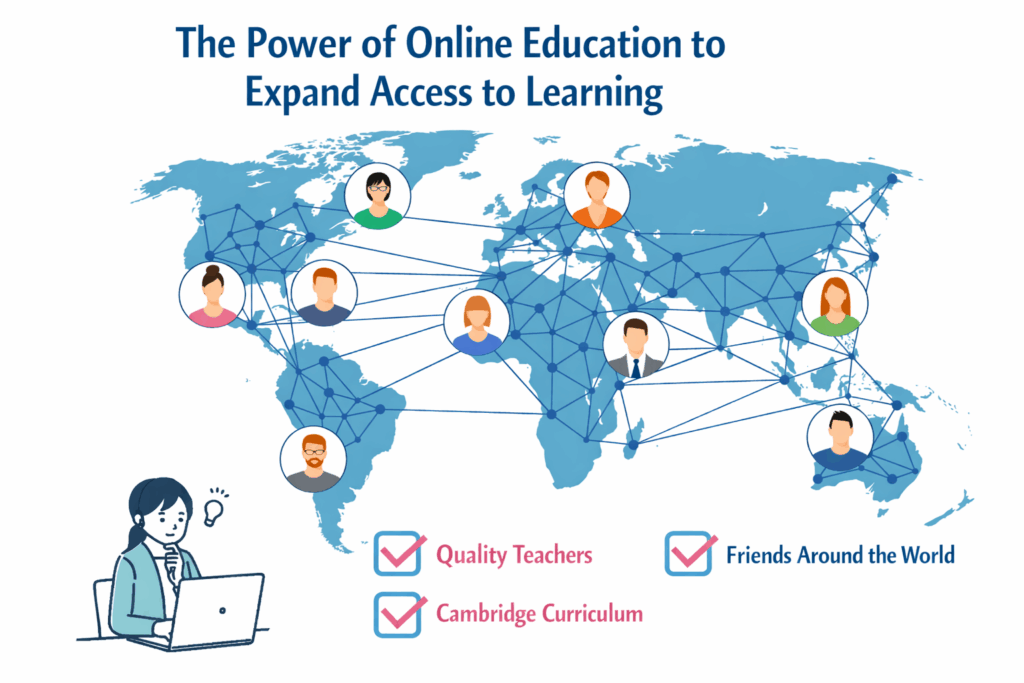
A major benefit of online international schools is easier access to highly qualified teachers. While classroom-based schools are limited to local teachers, online schools can recruit teachers with the best expertise and teaching experience in their fields from around the world.
For example, students can receive full-scale lessons based on the Cambridge curriculum from a veteran science teacher based in the UK, right from their home in Japan. This dramatically improves the quality of education. Another attractive feature is the flexibility to design study time, taking advantage of the time difference and making effective use of the evening hours after school in Japan. This makes it possible to incorporate advanced education without making major changes to your current lifestyle.
Individually optimized learning support allows you to continue without strain
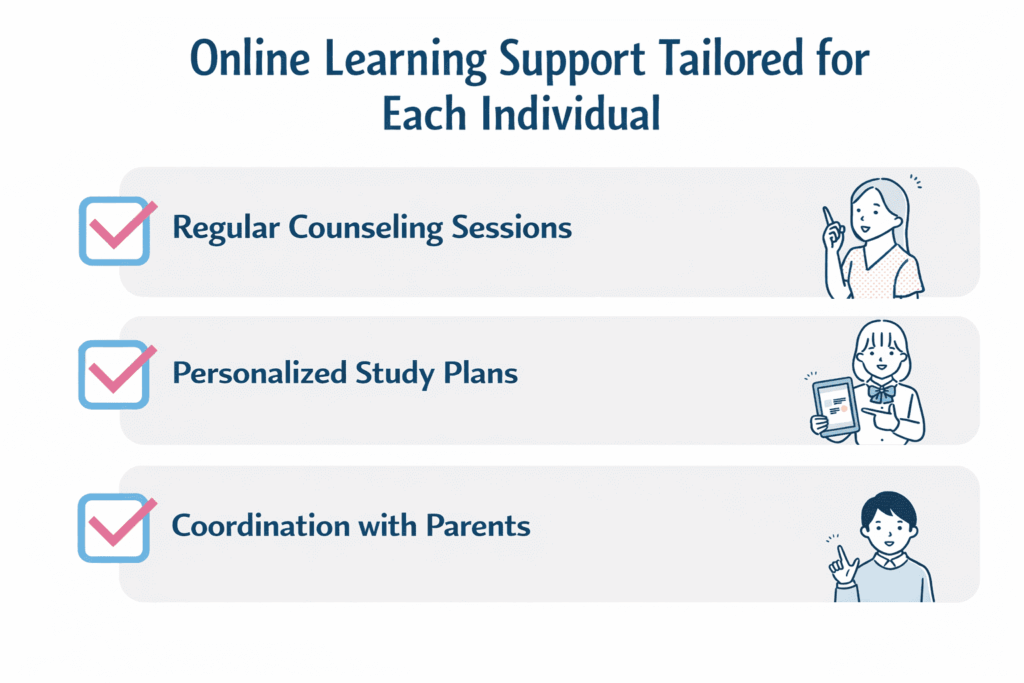
When you hear about online learning, some people may worry that their parents will have to be by their side the whole time. However, high-quality online international schools have a comprehensive support system in place to ensure that each student can progress smoothly through their studies.
For example, learning progress is accumulated as data, and the system automatically improves areas of weakness.analyzeBased on this data, the counselor or advisor in charge will meet with the student regularly to review the learning plan and follow up on any areas where the student is struggling. We also work closely with parents and share information about their child’s learning situation, making it easier for them to provide support at home.
In this way, by providing “individually optimized” support that is tailored to each child’s personality and level of understanding from both the technological and human perspectives, children can concentrate on their studies with peace of mind and steadily improve their skills.
Nisai’s learning plan makes it possible for elementary school students to aim for the world
For those who are interested in the option of online international schools, here we will introduce the specific learning plans offered by Nisai, which will help your child start from elementary school, acquire world-class English skills, and broaden their future options. We will support you with a consistent curriculum, efficiently raising your child’s CEFR level and leading them to obtain an internationally recognized qualification.
Start by improving your English skills and solidify your foundation with the CEFR English course
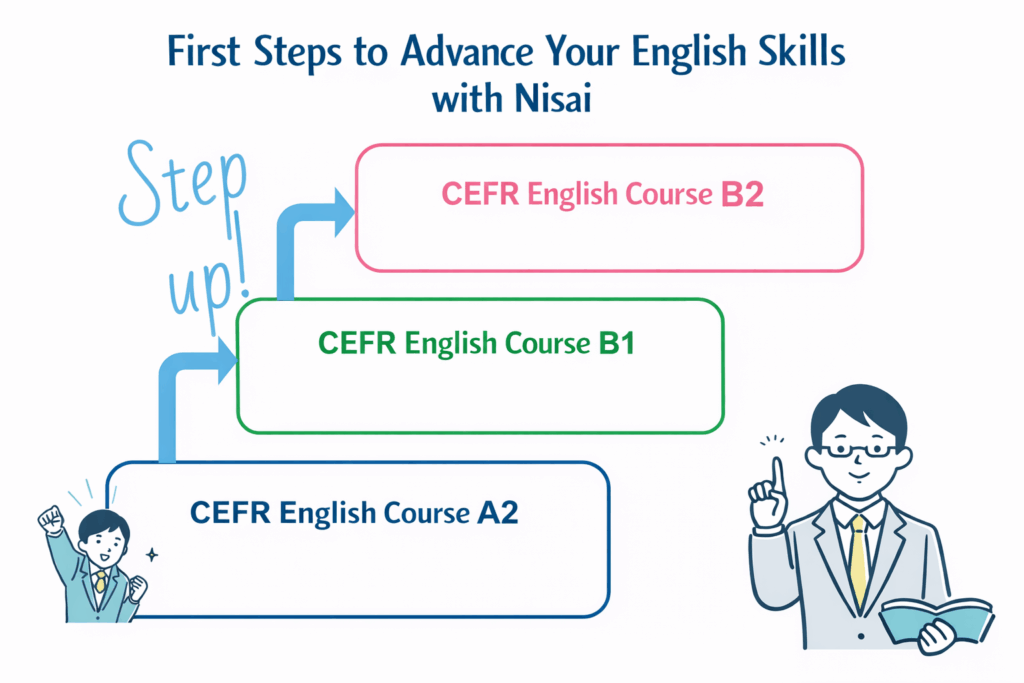
The CEFR English Course is ideal for children who want to gain confidence in their English communication skills before moving on to full-fledged academic studies, or who want to take the next step after attending an English conversation class. As the name suggests, this course is a program specialized in raising the CEFR level, with the aim of providing balanced and intensive training in the four English skills (reading, listening, writing, and speaking). Live lessons with experienced, specialized native teachers are held in small classes, with plenty of opportunities to speak, allowing students to acquire practical communication skills.
By setting clear goals based on the CEFR standards and conducting regular level checks, both children and parents can see their progress as they progress through their studies. Building a solid foundation of English ability here will lead to a smooth transition to an international curriculum later on.
Elementary school courses lay the foundation for the Cambridge curriculum
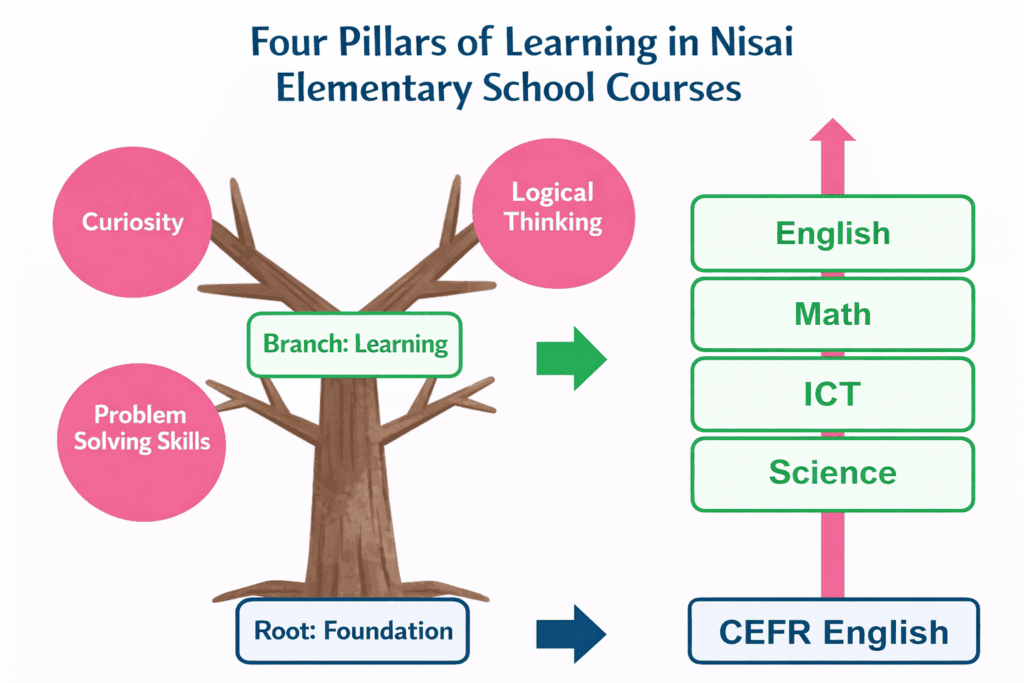
Once students have a solid grasp of the basics of English, they can move on to the stage of learning “in” English. In Nisai’s elementary school course (for ages 11-14), students learn all of the main subjects, including English, mathematics, science, and ICT (information and communication technology), in English. This curriculum is based on the Cambridge International Programme, which is used in over 160 countries around the world, and is characterized by an “inquiry-based” learning style that explores the essence of things, rather than simply memorizing knowledge.
Students think about why something is the way it is, explain it in their own words, and discuss it with their peers. Through this process, they develop logical thinking and problem-solving skills, which will be essential in the coming age. By being exposed to a world-class education from an early stage, they can build a solid foundation for success on the international learning stage.
For junior and senior high school students: From IGCSE to A-Level, obtain a world-class qualification
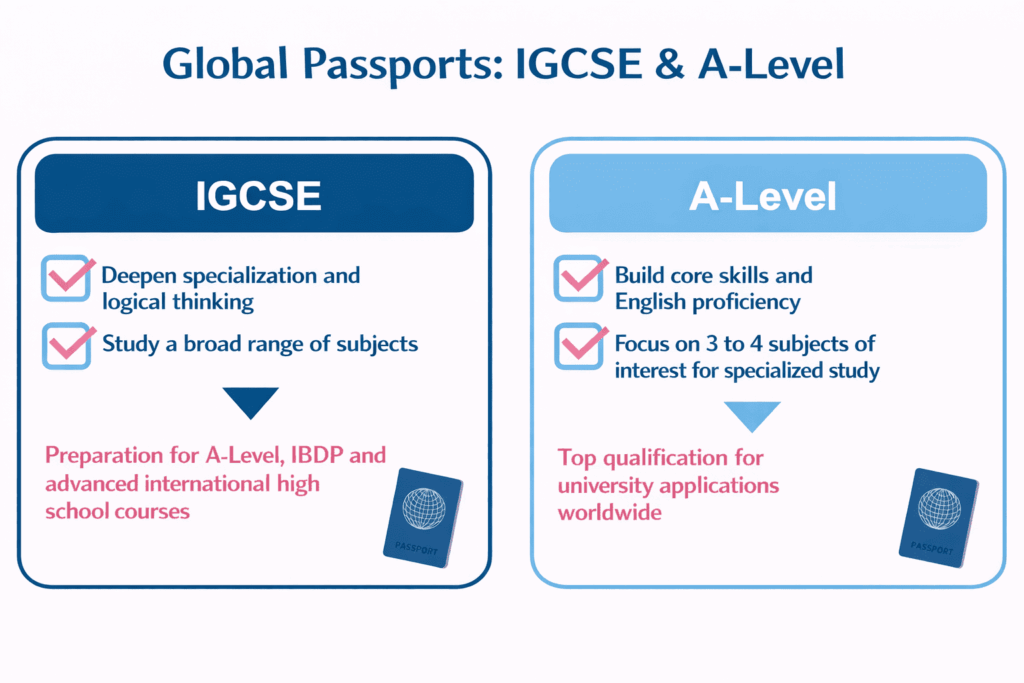
Nisai offers courses for junior and senior high school students leading to IGCSE and A-Level qualifications that are widely recognised internationally.IGCSE(for 14-16 year olds) is the UK’s compulsory completion qualification and is a goal standard adopted by international schools around the world. Students choose from a wide range of subjects based on their interests and strengths and study them in depth over two years.
And beyond thatA-Level(for 16-19 year olds) is recognized as a qualification for university admission in the UK and is a prerequisite for those aiming to enter top universities overseas. Students focus on three or four strong subjects and specialize in university-level liberal arts courses. Obtaining these international qualifications is a powerful tool to prove your child’s academic ability to global standards, giving them an overwhelming advantage when it comes to entering universities both in Japan and abroad.
The importance of internationally recognized qualifications, with the possibility of studying at a university abroad in mind
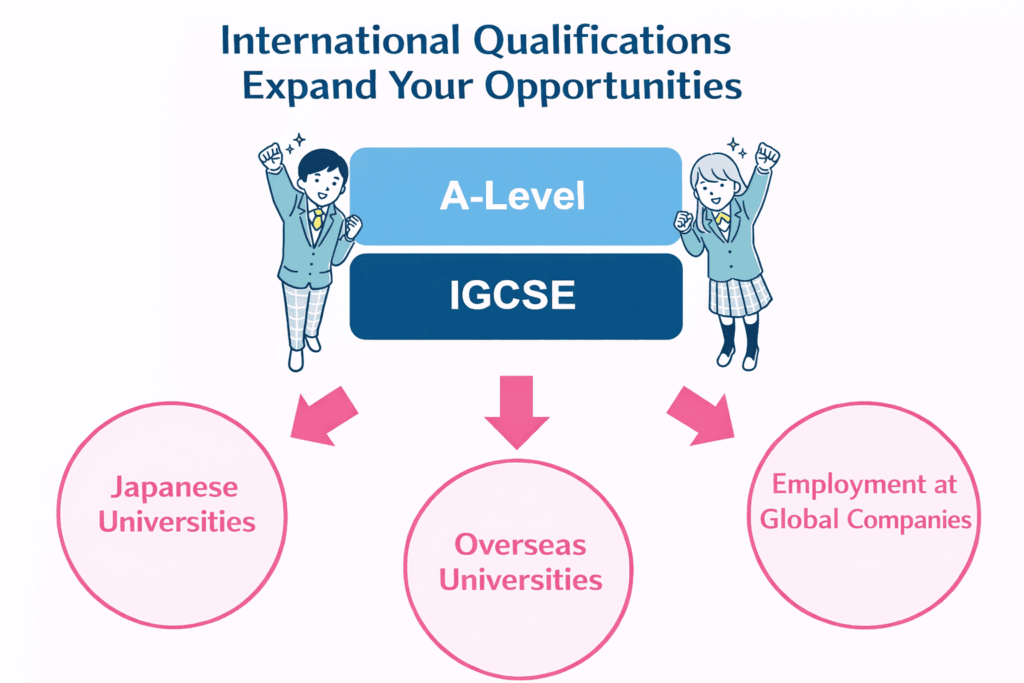
Why are international qualifications such as IGCSE and A-Level important? The reason is that these qualifications are more than just proof of academic ability; they are highly regarded by universities around the world as indicators of students’ independence and inquisitiveness.
In particular, in the AO entrance exams and comprehensive selection procedures that have been increasingly adopted by Japanese universities in recent years, those with international qualifications tend to be highly favorably evaluated as students with a strong desire to learn and expertise. Of course, these qualifications are a powerful passport when aiming to enter top universities overseas, such as those in the UK, the US, or Australia. When your child is forced to choose between a Japanese university or a university overseas in the future, ensuring they have the freedom to choose either path is the best gift you can give your child, who lives in an era of rapid change.
The secret to successful English education: Support for raising CEFR levels at home
No matter what educational environment you choose, support at home is essential to truly improve your child’s English skills. However, many parents worry, “I’m not good at English, so what should I do…?” will not be necessary. The important thing is not to treat English as a special “study,” but to create opportunities for children to naturally come into contact with it in their daily lives and foster motivation for learning together as parents and children. Here are some tips for support that you can put into practice right away at home.
Goal setting is key: A roadmap for parents and children to share about learning English
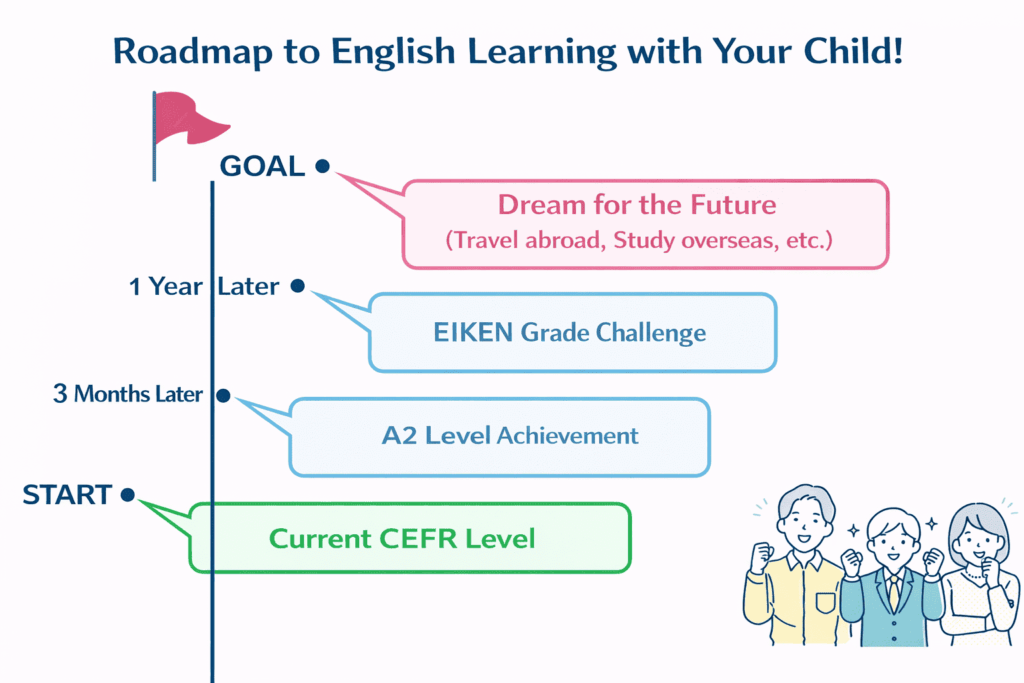
The most important thing for continuing to learn is to have a clear goal. So, we recommend that parents and children create an “English learning roadmap.” Set exciting, specific goals such as “In one year, I will be able to order food in English at a restaurant when traveling abroad (A2 level)” or “By the time I graduate from junior high school, I will be able to understand my favorite foreign films without subtitles (B1 level).”
Then, to reach that big goal, small steps are set, such as “read one short picture book in three months.” This roadmap can be posted on the wall of a child’s room, and by putting a sticker on each completed step, children can visualize their progress in a game-like way, which can make a big difference in their motivation. Rather than unilaterally imposing goals on them, it is most important that parents respect their child’s own desire to achieve something and make a plan together.
Don’t just study English – develop the habit of enjoying English in your daily life
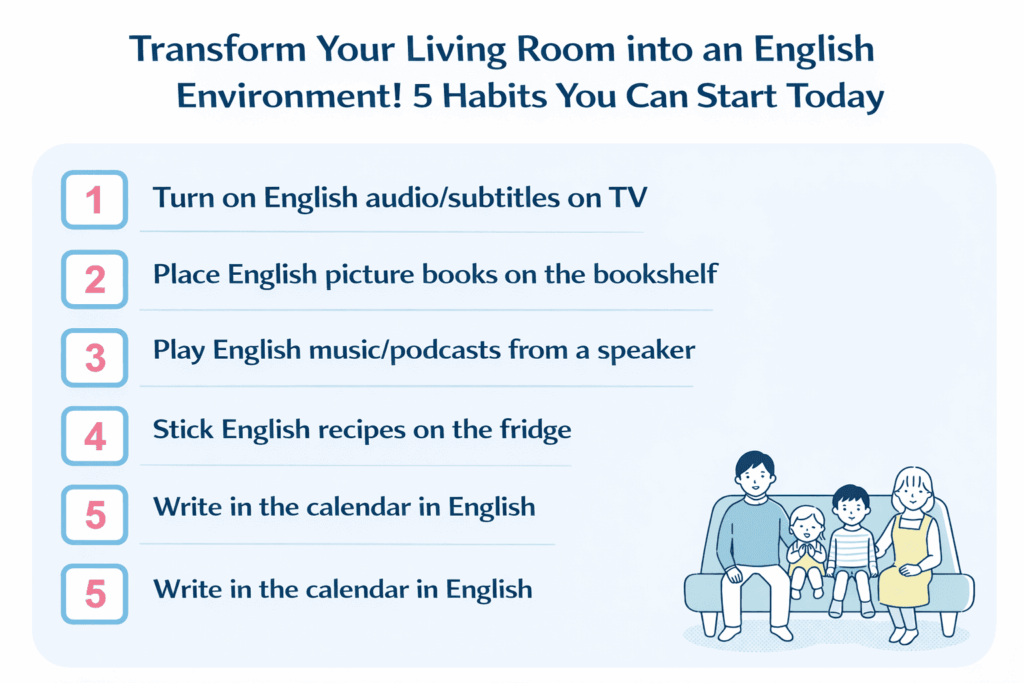
Repeatedly telling your child to “study English” is counterproductive. Instead, create an environment where English is a natural part of their daily lives.
For example, start by watching the anime or movies you normally watch with English audio and Japanese subtitles. Even if you can’t understand at first, your ears will get used to the sounds and rhythm of English. Once you get used to it, you can try watching with English audio and English subtitles.
It’s also effective to say the names of ingredients like “apple” and “carrot” in English while preparing meals, or to hang up waterproof alphabet posters in the bathroom. The important thing is not to aim for perfection. The quickest way to improve your child’s English skills is to create as many moments as possible throughout the day that make them feel that “English is fun.”
Learning from Nisai students: Commonalities between families who dramatically improved their English skills
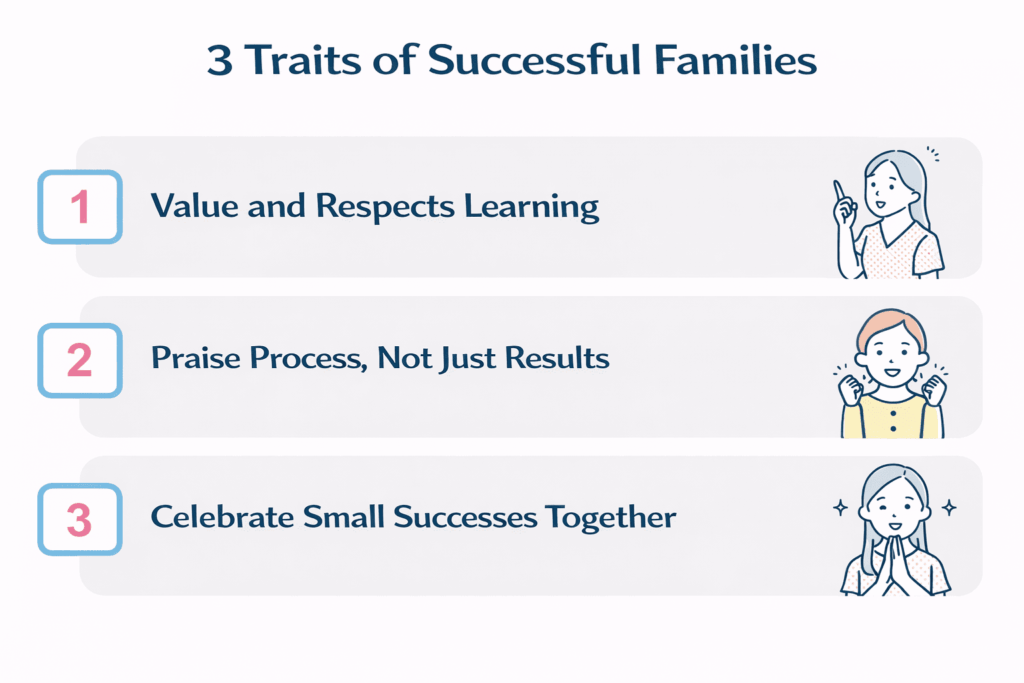
I have supported many families with their English education, and I have noticed that families with children growing up have several things in common.
The first one is,parents understand and respect their child’s learning styleLearning online is a big challenge for children. If parents understand Nisai’s curriculum and teaching policy and show their support for their children’s learning, they can study with peace of mind.
The second one is,“Praise the process, not just the resultIt’s not just “You got 100 points on the test, that’s great!” but also “You were concentrating hard in the lesson today,” “You worked hard on a difficult assignment until the end, that’s amazing!” and other words of recognition for your child’s daily efforts will help develop a sense of self-worth.
And the third one is,Celebrate small successes togetherWhen your child moves up one CEFR level, or when they are able to express their opinions in English, celebrating their progress as a family will give them great energy for their next learning.
The first step to thinking about your child’s future with an educational advisor
By reading this far, you hope to have a deeper understanding of the importance of the CEFR and how to choose an English education environment that is right for your child. However, when it comes to actually taking concrete action, you may have new questions or concerns, such as, “Where should I start for my child?” If this happens, please feel free to consult with our educational experts. At Nisai, we offer programs to support your child’s first steps to maximize their future potential.
First, understand your current situation with a free assessment test
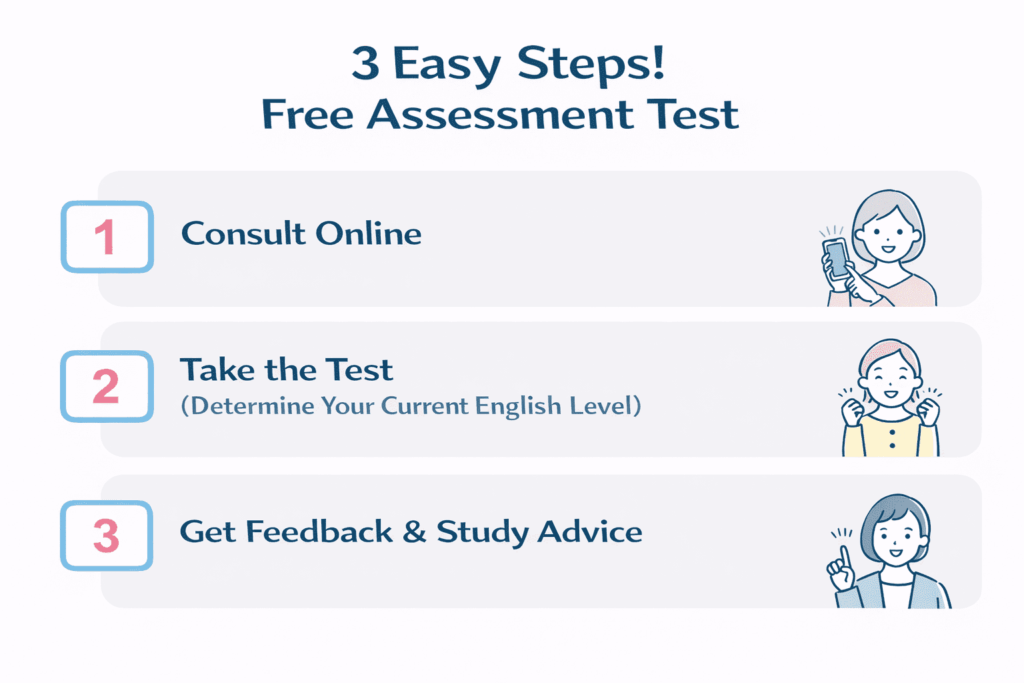
In order to create the optimal learning plan, it is essential to first accurately understand your child’s current English proficiency, that is, their CEFR level. Nisai offers online tools that allow you to easily check your own English level, as well as free assessment tests in which experienced native teachers will evaluate your child’s English ability from multiple angles. Based on these results, you can clarify your child’s strengths and areas that need to be improved in the future, and this can be the first step in setting specific learning goals. Please feel free to try it out and use it to understand your child’s current situation.
Consult with an expert to relieve your anxiety. Information on individual online counseling
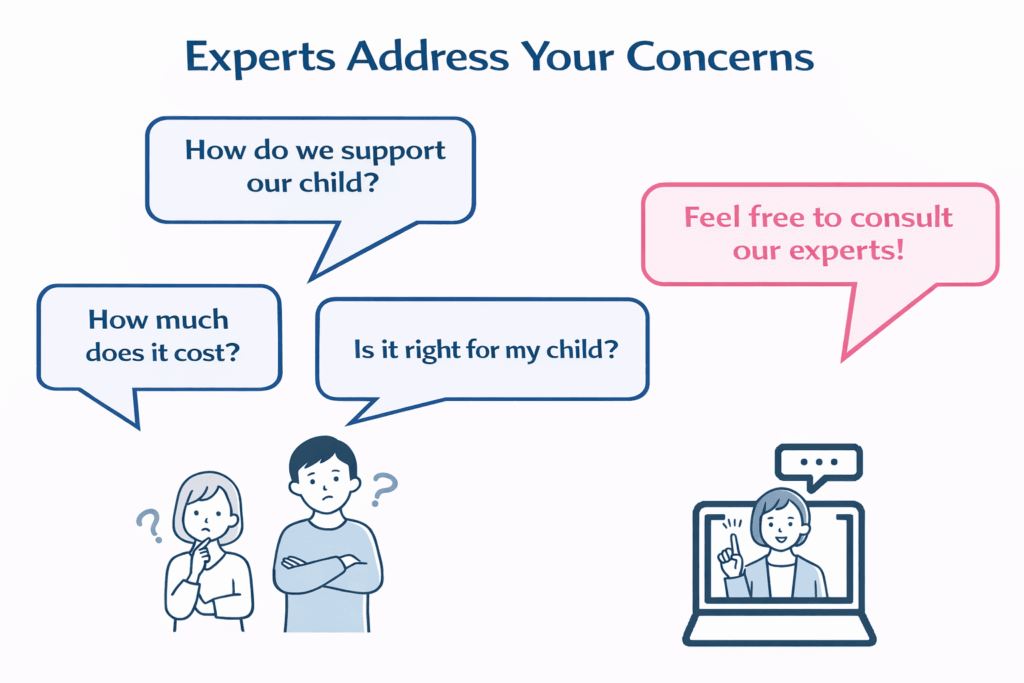
“I’m interested in online schools, but I’m worried about whether they’re right for my child,” “I want to know more about the costs and curriculum,” “I want specific advice on how to support at home,” etc. There are as many worries and questions as there are families. At Nisai, our support staff will carefully listen to the situation of each parent and provide individual consultations (free of charge) to resolve any concerns. Our experienced staff will comprehensively consider your child’s personality, learning situation, future goals, etc. to propose the optimal learning plan. No matter how trivial the matter, it doesn’t matter. Don’t try to handle it alone; please feel free to consult with our experts.
Materials to read if you are unsure about choosing an international school
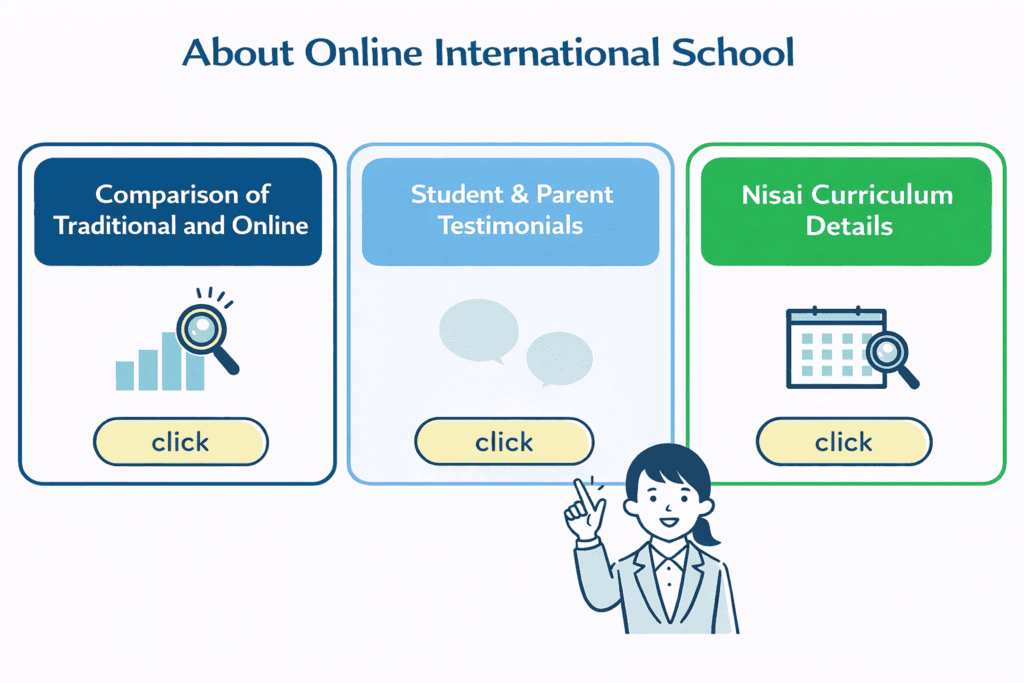
Decisions regarding your child’s education are very important for families. We want you to compare and consider various information and make the best choice after you are satisfied. That’s why Nisai provides a variety of information on its website that will help you choose an international school.
For example, it is packed with immediately useful information, such as a comparison between on-campus and online international schools, feedback from current students and parents, and detailed information on Nisai’s curriculum. Reading these materials will deepen your understanding of online learning and allow you to make more specific considerations. They are easily accessible from the website, so please use them as one way to gather information.
summary
This article provides a detailed explanation of the CEFR level, a global standard for English proficiency, from its overview to comparisons with other tests like the EIKEN® and how to choose the optimal educational environment based on the CEFR. The CEFR is a compass that visualizes and objectively assesses your child’s English ability, which has traditionally been perceived intuitively, by showing them in concrete terms what they can do. There’s no need to feel anxious about comparing your child to others. The important thing is to accurately understand your child’s current level and chart a learning path that suits their individual personality and goals. In addition to on-campus international schools, online international schools like Nisai are also effective options. We hope you’ll use this article as a reference and take the next step toward maximizing your child’s potential.

![[Expert Explains] What are CEFR Levels? Don't worry about comparing your child's English ability with others!](https://en.nisai-british-onlineschool.com/wp/wp-content/uploads/2026/01/cefr-english-levels-660x380.png)