

- A-level
- 2026.1.5
A-levels are difficult, but they actually have many benefits. They are the shortest route to top universities both in Japan and overseas.
Why is “A Level” so popular now? Learn about international standards in English education before you panic and compare yourself to others.
In today’s increasingly globalized world, interest in English education for children is on the rise. In particular, as the option of international schools becomes more accessible, you may have heard the term “A-Levels” more often. Here, we will explore why A-Levels are attracting attention these days and the real concerns parents have about them.
Have you ever been surprised by the English ability of a mom friend’s child?
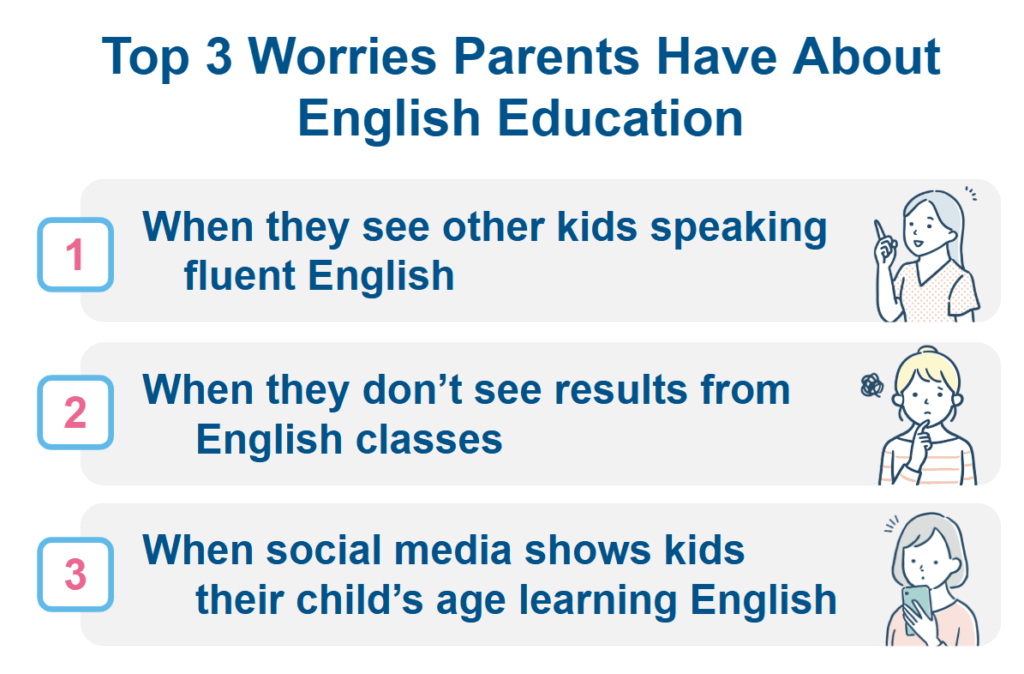
“So-and-so’s English was amazing at the luncheon the other day.” When a topic like this comes up in a conversation with a mom friend, do you ever feel a little nervous inside? Even though you nod along with a smile, somewhere in your heart you feel a vague sense of anxiety, wondering, “I wonder if my child is okay…” As a mother myself, I can understand that feeling all too well.
In particular, even if your child seems to enjoy attending an English conversation school, you may not be sure whether this is leading to “usable English skills” that will be useful in the future.
The important thing is not to compare yourself to others and feel anxious, but to look to your child’s own future and find out what the best educational options are. One key to this is the “A Levels,” which we will introduce here.
“Is my child enjoying English?” True skills that can’t be gained through English conversation schools alone
A once-weekly English conversation class is a good opportunity to become familiar with English, but it may not be enough to move on to the stage of “learning something in English.” Once children move beyond the stage of having fun interacting with English through songs and games, the next thing they need is the ability to think and express themselves using English as a tool.
For example, experiences such as reporting on science experiments in English or discussing history in English cannot be gained through mere English conversation practice. It is through these types of learning that children will acquire the real English skills they need to succeed on the world stage in the future. If you feel that your child’s English skills are not improving at the moment, it may be a sign that you need to reconsider the “quality” of their learning. An environment that not only develops English skills but also develops their thinking skills and inquisitiveness is essential for the next step.
What are A-Levels? A world-class university entrance qualification that broadens children’s future options
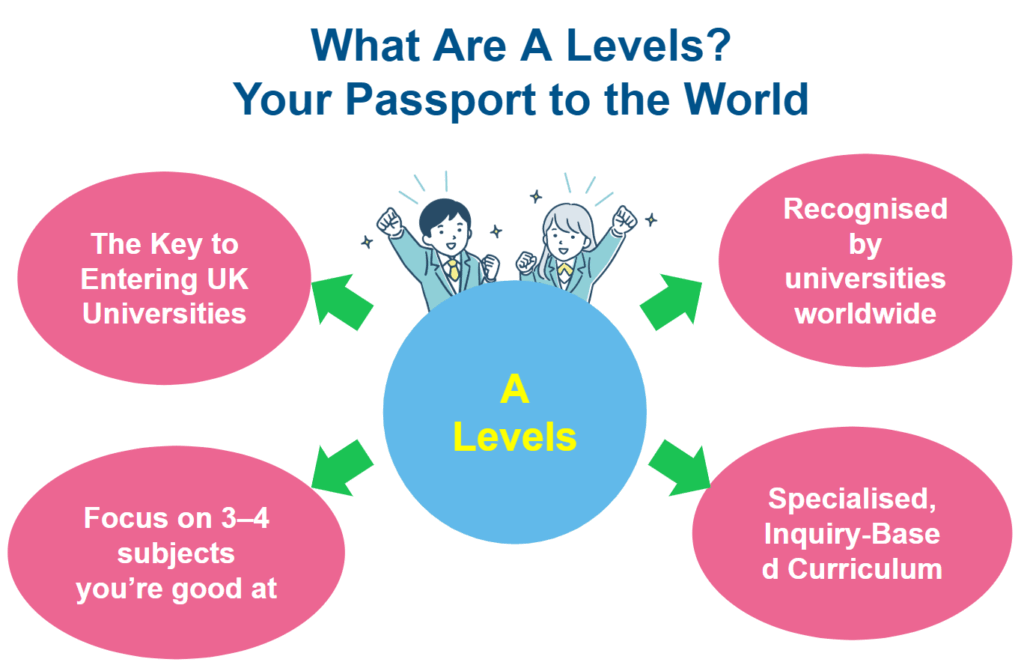
“A-Levels (official name: General Certificate of Education Advanced Level)” is a qualification for university entrance in the British education system.UniversityIt takes two years of study and a final exam to progress to a British university. The qualification is recognised as an official entry qualification at many universities around the world, including those in the UK, the US, Australia, Canada and Japan.
In other words, obtaining A-levels means that your child will have a strong passport when aiming to enter a university in Japan or abroad in the future. A major feature of this exam is that instead of studying many subjects broadly like in Japanese university entrance exams, your child can focus on three or four subjects that they are truly interested in or good at, and study them in depth and specialization.
A-Level Difficulty Explained | From Differences with IB to Admission to Universities in Japan and Abroad
Even if you understand that A-Levels are an international qualification, you’re probably still wondering about their difficulty. How do they compare to Japanese university entrance exams and the IB (International Baccalaureate), another international qualification? Here, we’ll provide a multifaceted explanation of the difficulty of A-Levels, including the specific learning content and assessment methods, and provide information to help you decide whether they’re the right choice for your child.
UniversityFirst yearLevel? A-level study scope for in-depth and specialized learning
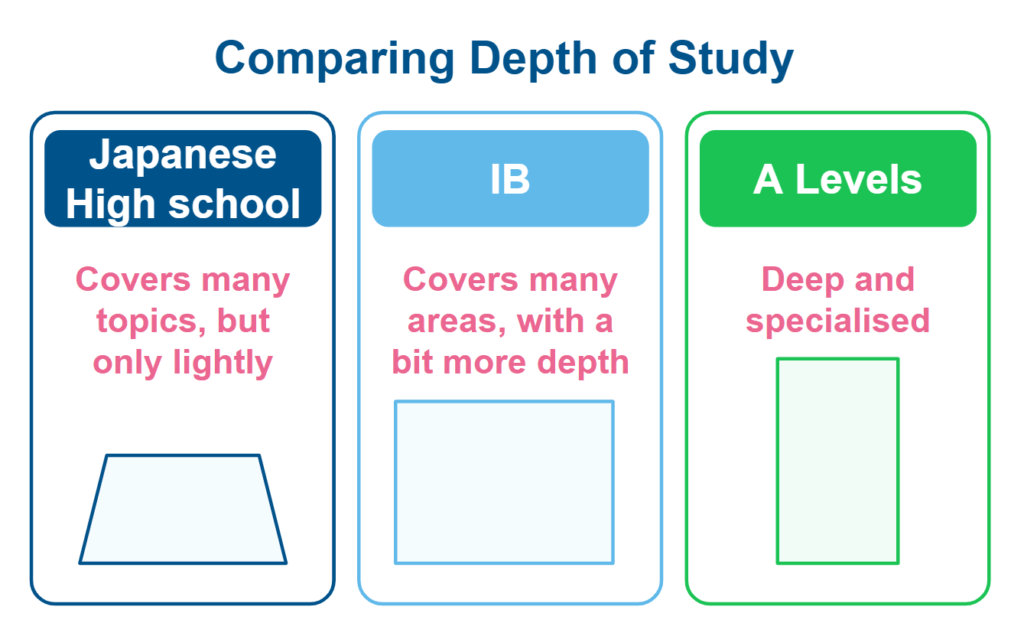
The main reason why A-level study is considered difficult is because of its high level of specialization. The scope of study is said to be equivalent to the level of a first-year university student in Japan (general education course), and it requires deep understanding and the ability to apply knowledge rather than simply memorizing it.
For example, in physics, students not only need to memorize formulas, but also the ability to theoretically explain the background behind those formulas and apply them to complex problems. In history, students are required to critically analyze historical documents and logically express their own views, rather than simply memorizing dates and events. This is an extremely challenging curriculum for children who want to thoroughly pursue their fields of interest, but what makes the A-Level so difficult is that it requires a high level of thinking ability and a spirit of inquiry.
Are exam results everything? What you need to know about A-level grading
Another major feature of the A-level is that final grades are determined solely by the results of a standardized examination administered at the end of the course. This is quite different from the evaluation method used in Japanese high schools, where daily class attendance, assignments, and quizzes are also taken into account.
In other words, the results of two years of study will be decided in one final test. While this can work to the advantage of children who are good at taking exams, it can also be a source of great pressure for children who tend to get nervous easily.
The difficulty with this evaluation method is that it requires not only continuous effort, but also the mental strength to perform at your best on the day of the exam. However, because the exams are divided by subject, it also means that if you do poorly in one subject, you can make up for it in the others.
Comparing the difficulty levels of A-Level and IB: Which is right for your child?
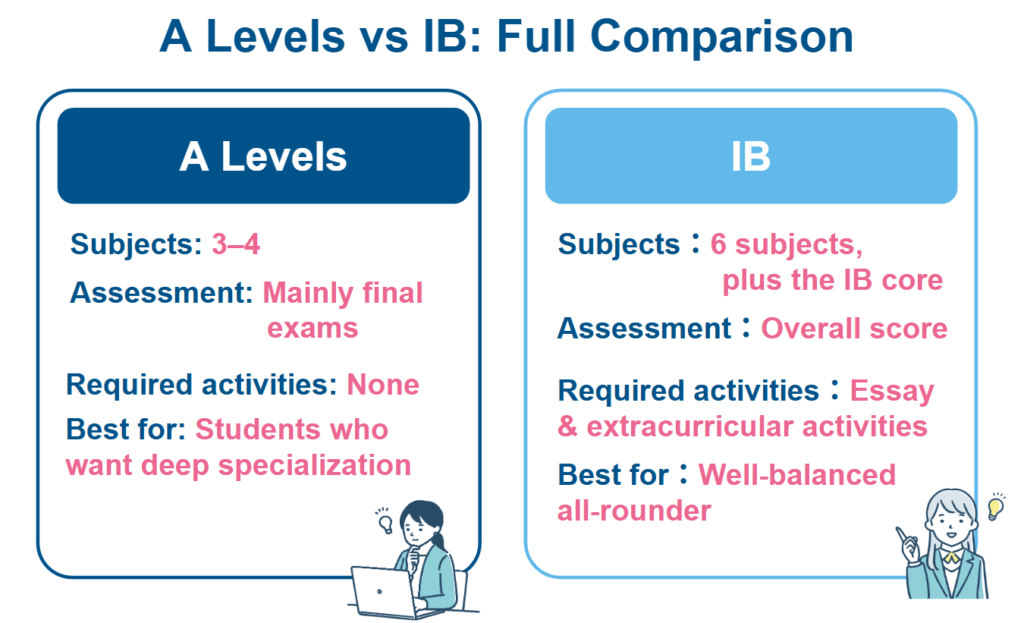
When considering an international school, the IB (International Baccalaureate) is often compared to A-levels. It is difficult to say which is more difficult, but the “type” of difficulty is different.
As mentioned above, A-levels are extremely difficult academically because they require students to delve deeply into their chosen subjects. On the other hand, IB requires students to choose subjects from six fields and also requires an essay (EE) and extracurricular activities (CAS), making it more challenging overall, requiring a wide range of abilities and self-management skills.
To put it in perspective, A-levels are a program for developing “specialists,” while IB is a program for developing “generalists.” A-levels tend to be suitable for children who have a clear idea of the field they want to study at university, while IB tends to be suitable for children who want to find their aptitude while learning broadly.
Explaining the pros and cons: Is A-levels the right choice for your child?
Based on what we’ve explained so far, let’s summarize the advantages and disadvantages of A-levels. The biggest advantage is that you can focus on subjects you’re good at and deepen your specialized knowledge that will be directly related to your studies at university while you’re still in high school. This reduces the chance of a mismatch after you enter university. Another advantage is that, compared to the IB, there are no compulsory extracurricular activities, making it easier to focus your study load on specific subjects.
On the other hand, one disadvantage is that children must decide in their first year of high school what field they want to study at university, i.e., what subjects they will take at A-level. This can put a lot of pressure on children whose dreams for the future are still vague. Also, the one-shot exam evaluation method may not be suitable for some children, depending on their personality. It is important to take these points into consideration comprehensively and make a decision based on your child’s interests and personality.
Which overseas and domestic universities will give you an advantage if you take A-levels?

Because A-Levels are based on the British education system, they are the most suitable qualification for entry into all British universities, including Oxford and Cambridge. However, their validity extends beyond the UK. Top American universities such as Harvard and Yale also highly value high A-Level scores as proof of academic ability.
In recent years, Japanese universities have become increasingly internationalized, and many universities, including the University of Tokyo, Kyoto University, Waseda University, and Keio University, have introduced entrance examination systems that recognize A-levels as an admission qualification (such as the International Barrocalera and A-level Entrance Examinations). In particular, in science faculties that require a high level of specialization, experience studying specific subjects in depth at A-levels can be a major advantage. We recommend that you research in advance how the university your child wants to attend evaluates A-levels.
Which international school is right for your child? Types of international schools and how to choose one
Even if you have your A-levels in sight, the next question that comes to mind is, “So, where should I study?” International schools are a common option, but they actually come in a variety of styles. Here, we’ll compare the features of each and consider how to choose a school that suits your family’s lifestyle and your child’s personality.
The benefits of attending international schools and the burden on families
The major appeal of commuting international schools is their spacious campuses and comprehensive facilities (swimming pools, gyms, libraries, etc.). Meeting friends from a variety of nationalities every day allows students to naturally interact with different cultures and develop their communication skills. Another advantage is the face-to-face learning environment, where students can ask questions directly to teachers and work on assignments together with friends.
On the other hand, one of the disadvantages is that tuition fees tend to be high. Also, depending on the school’s location, daily transportation to and from school can be a significant burden, and there may be physical constraints, such as there being no school within commuting distance. Another thing to consider is that there are many situations where parents are required to be involved, such as attending parent-teacher meetings and events.
Another option: online international schools
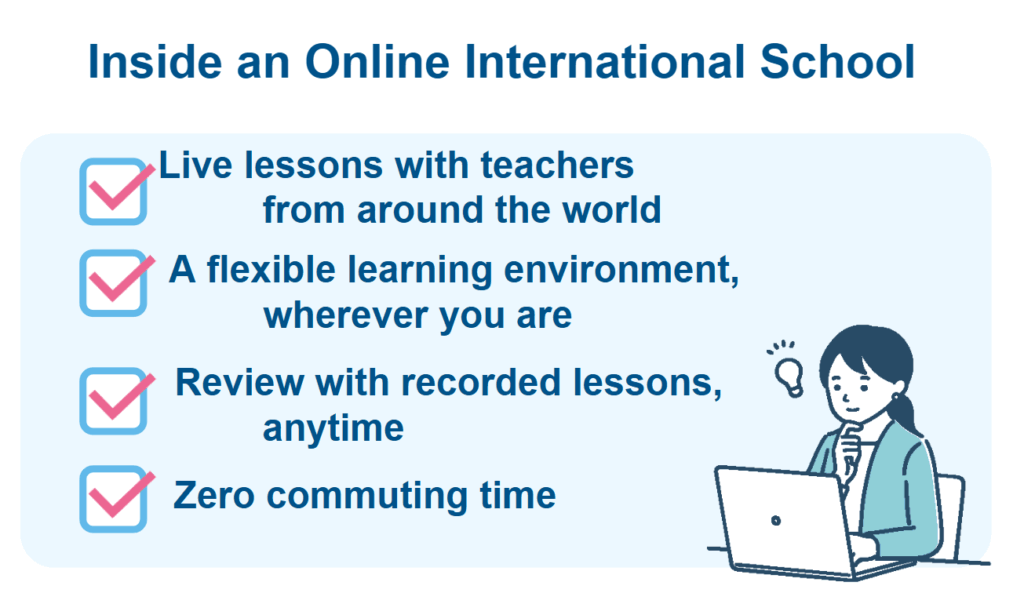
In recent years, a new option that has been rapidly gaining attention is “online international schools,” which allow students to learn the curriculum of international schools from anywhere in the world via the internet.
The biggest advantage is that it can be done anywhere. Even if there is no international school in your area, your child can receive a high-quality international education. Also, since there is no need for the time or expense of commuting to school, that time can be spent on activities your child enjoys or further learning. Another big attraction for parents is that tuition fees tend to be lower than in-person schools. At first, you may be worried about whether your child will be able to make friends online, but there are also many virtual social events taking place.
Compare costs and learning styles! Three points to find the best environment for your home
To choose the best school for your child and family, we recommend comparing three points.
The first is “cost.” You should understand the total cost of graduating, including not only tuition fees but also commuting expenses, textbook fees, and extracurricular activities. Online schools often have a significant advantage in this regard.
The second factor is your learning style. If you value face-to-face communication, then a classroom-based course might be a better choice. If you want to learn at your own pace and concentrate, or if you want to balance your studies with other extracurricular activities, then an online course might be a better choice.
The third is the “support system.” It is very important to consider how much support the school provides, such as progress management and career counseling. In particular, be sure to check whether there is individual support tailored to your child’s personality and learning level.
Why choose Nisai? 3 reasons to study A-levels online
Among online international schools, Nisai is chosen by many students around the world. This is because we don’t just offer online classes, but also provide a unique educational environment that maximizes your child’s growth. Here are three reasons why Nisai is the best choice for children aiming for A-levels.
Over 25 years of experience | High-quality live lessons by professional native teachers
Nisai has a history and track record of over 25 years in the field of online education. Our greatest strength is the high quality of our teachers. All Nisai teachers are UK-qualified professionals who meet strict recruitment standards and receive specialized training for online teaching. Rather than watching a recorded video, lessons are conducted in real time through “live lessons,” allowing students to ask questions and exchange opinions with their classmates. This two-way communication dramatically increases your child’s motivation and comprehension. Nisai’s greatest appeal is the ability to receive high-quality lessons based on years of experience from the comfort of your own home.
Cultivate an international perspective in a global environment where you can learn with peers from all over the world
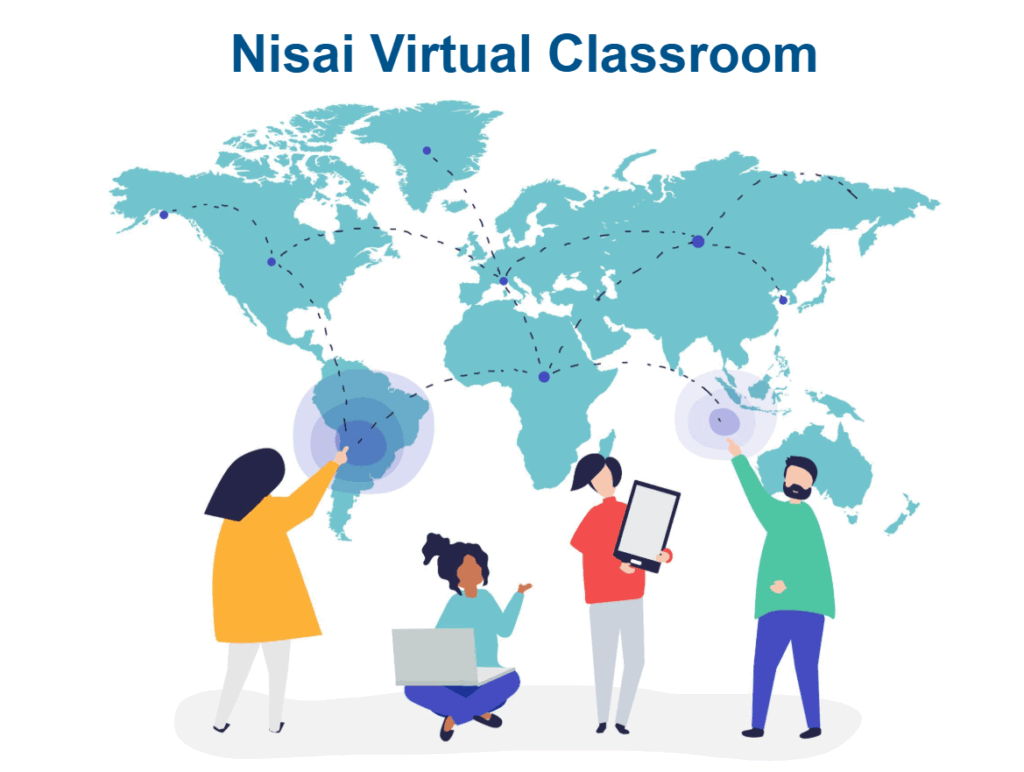
Although it is an online school, Nisai’s classrooms are surprisingly global. Students from over 30 countries around the world, including the UK, the Middle East, and Asia, come together to study in the same classes. This is a rare opportunity to experience diverse cultures and values.
For example, if you discuss a single event in history class, different countries may have completely different perspectives on the topic. These experiences are crucial for helping your child embrace diversity and develop an international perspective.
Even at international schools where students attend classes, there is a wide variety of nationalities, but at Nisai, students can overcome physical distance and connect with peers from even more diverse backgrounds. This environment is what will foster truly global talent.
Nisai’s personalized learning support and counseling
At Nisai, our number one priority is to provide close support to each and every student. We offer comprehensive support to ensure students do not feel isolated during online learning. Learning progress is constantly monitored by the system, and if a student is found to be falling behind, a teacher will immediately follow up.
We also provide a wide range of support, from academic concerns to career advice. For challenging courses like A-levels, creating a study plan and maintaining motivation are key to success. At Nisai, our experienced staff work as a team to help your child achieve their goals, so you can focus on your studies with peace of mind.
Eliminate the “It might not be possible for my family” mentality! International school costs and parental involvement
“International schools seem to be expensive and a big burden on parents…” This image makes many people hesitant to consider them as an option. However, the online option significantly lowers this hurdle. Here, we will provide information to allay any concerns you may have about specific costs and how parents should be involved.
What about tuition fees? A detailed comparison of on-campus and online tuition fees
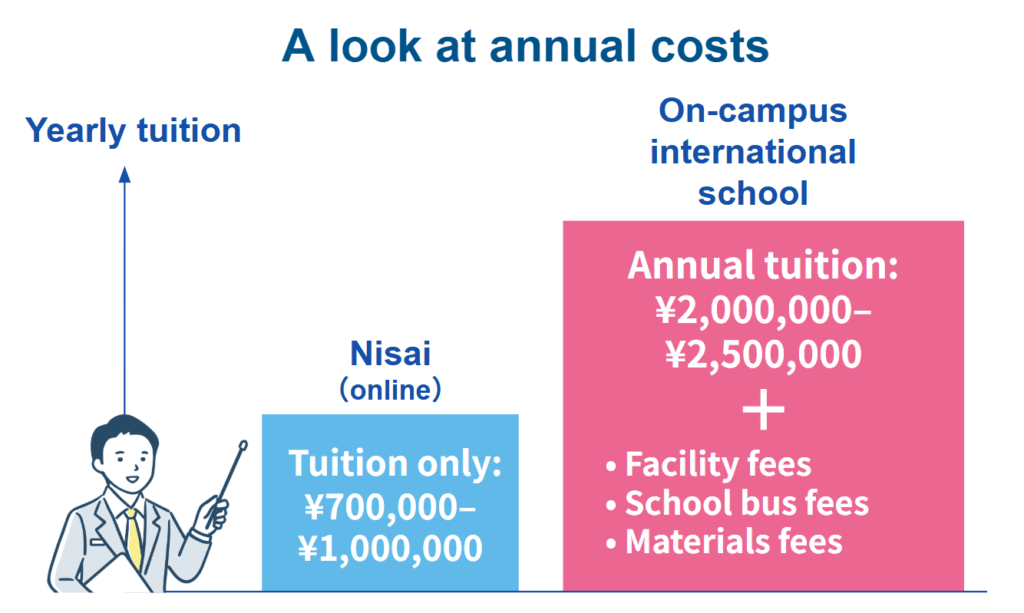
The tuition fees for international schools are probably the most important consideration. Generally, it is said that annual tuition fees for commuter international schools in Tokyo are around 2 million to 2.5 million yen. In addition to that, there are often costs for facility maintenance, school bus fares, and textbook fees.
On the other hand, online international schools like Nisai can keep annual tuition fees to under 1 million yen, even for A-level courses. This is because they don’t need to maintain large campuses or facilities, and can instead provide high-quality education and reasonable tuition fees. Online schools can be a realistic option for families who have previously given up on education due to the financial burden.
With Nisai, you can rest assured! A support system that reduces the burden on parents regarding English ability and time.
We often hear parents say, “If parents can’t speak English, they’re worried about communicating with the school.” But don’t worry. At Nisai Japan, we have staff on-site who can speak Japanese. We will provide all support in Japanese, including consultations and procedures related to learning, so even parents who are worried about their English ability will have no problems.
Additionally, with online schools, there is no need for daily transportation and lunch preparation, which can be a burden at schools that require students to commute to school. Parent meetings and interviews are also all held online, so even parents who are busy with work can participate at a time that is convenient for them. In this way, Nisai has put in place a system that significantly reduces the time and psychological burden on parents.
How to balance education with Japanese education? Differences in curriculum that you should know
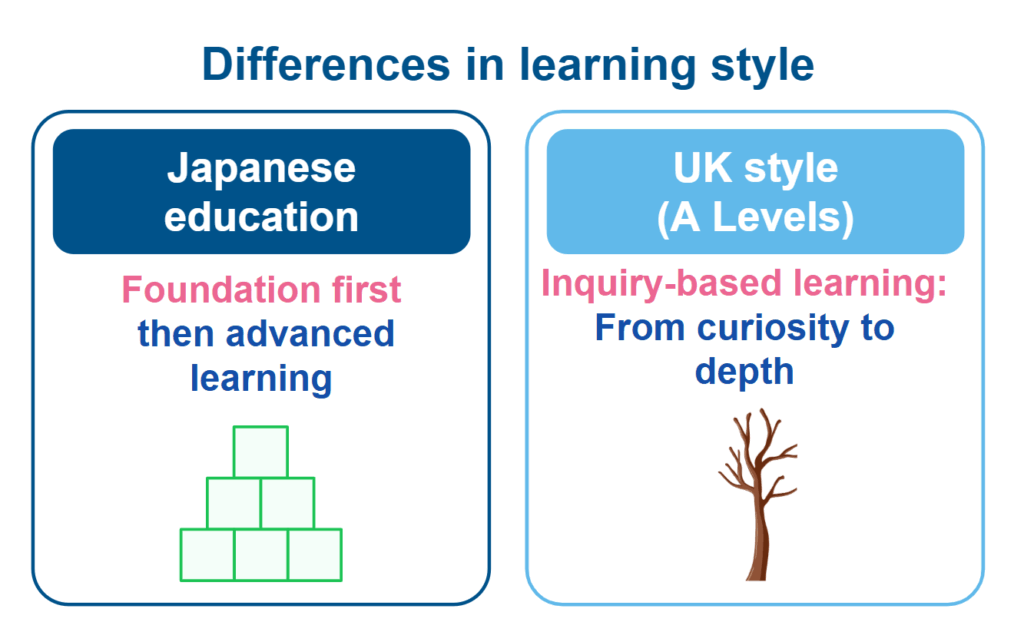
The A-level curriculum does not cram knowledge into students, but instead places emphasis on students asking questions and exploring for themselves. This is a different approach from Japanese education, which builds up knowledge step by step from the basics. It is not that one is better than the other, but rather that it requires different types of thinking ability.
Nisai allows students to attend Japanese schools while taking only specific subjects after school. For example, students can choose to take only their favorite subjects, such as math or science, at Nisai and aim for A-levels. This flexibility, unique to online schools, allows students to take the best of both Japanese and international education.isWe will work together to find the best learning combination for your child based on their interests and goals.
How much support do you need for home learning?
When you hear about online learning, you might worry that parents will have to be by their side all the time. However, Nisai students develop the ability to study independently. Live lessons set the learning pace, and assignments are managed through an online learning platform, so children naturally develop the habit of planning and working independently.
What we ask of parents is not to “monitor” but to “watch over” their children. Providing a good learning environment and showing interest by occasionally asking “How was today’s lesson?” will help motivate your child. Our Nisai teachers and support staff are responsible for providing professional support in terms of learning, so you can watch over your child’s growth with peace of mind at home.
The first step to transforming anxiety and impatience into confidence | Maximizing your child’s potential
We’ve provided you with a wide range of information so far, from the difficulty of A-Levels to the option of online schools. With so much information, you may be feeling a little confused. But don’t worry. The important thing is not to decide everything right away. Start by sorting out your and your child’s concerns with an expert.
First, we offer a free educational consultation at Nisai to help you find the best learning plan for your child.
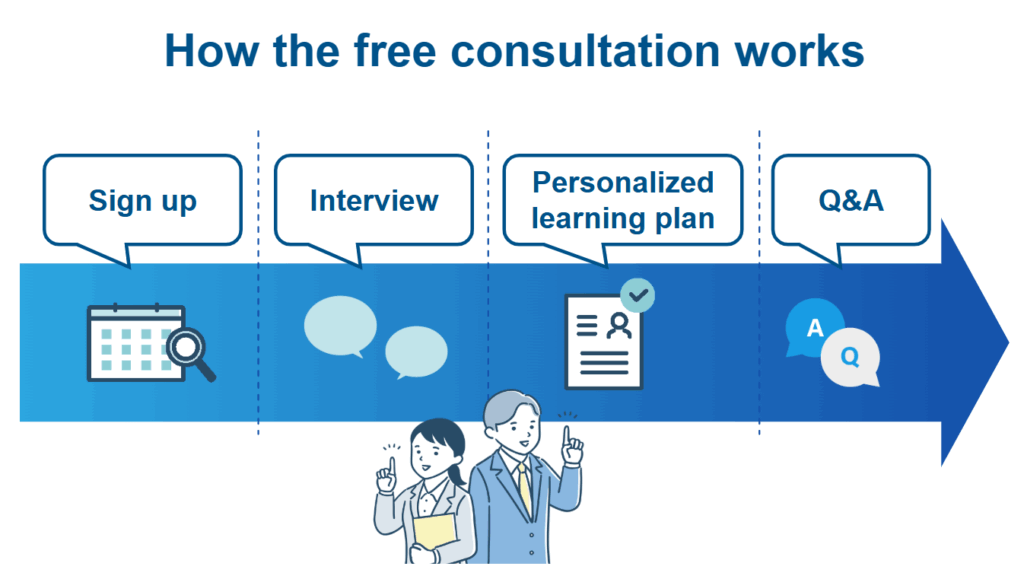
“Are A-levels really right for my child?” “I’m worried about whether they’ll be able to keep up with online classes…” If you have any questions or concerns like these, please let us know in a free one-to-one consultation at Nisai. Our support staff will speak directly with you and your child, and propose the best learning plan based on their current learning situation, future goals, and personality.
We never force students to take A-levels. Sometimes we suggest starting with IGCSE, which is the stage before A-levels, or taking an intensive course to improve your English ability. This consultation will help to alleviate any vague anxieties you may have and will be the first step towards setting concrete goals.
Experience world-class classes in a trial lesson at Nisai
Seeing is believing. Nisai offers a free trial program where children can participate in live lessons. By experiencing the joy of learning with peers from all over the world and interactive lessons with native teachers, your child may develop positive feelings such as, “I can do this!” and “It’s fun!”
By actually seeing the class in action, parents will also gain a deeper understanding of online learning and feel more at ease. Many students have used this trial lesson as a springboard to start their studies at Nisai with great confidence. We encourage you to experience the world-class education that Nisai offers at home.
The best educational investment for your child’s future
Your child’s education is the most valuable “investment” in their future. And the purpose of that investment should not just be to get them into a good university. The ability to think for yourself, the ability to accept diversity, and the communication skills to deal confidently with people from all over the world are all things truly necessary to survive in the future. Isn’t it true investment in education to develop these skills?
Taking on the A-Level challenge and studying at Nisai is a very effective option for your child to acquire these skills and carve out their own future. We promise to do our utmost to support you so that this important investment will produce the best possible return.
Summary
In this article, we will take a closer look at the difficulty of the A-Level, comparing it with the IB and Japanese education, and explain its characteristics and benefits. The difficulty of the A-Level lies in the high level of specialization, with the learning scope reaching university level, but the major advantage is that it allows children to focus on three or four subjects they are good at, allowing them to make the most of their strengths.
Common hurdles to attending international schools, such as high costs and a heavy burden on parents, can be significantly reduced by choosing an online school like Nisai. There’s no need to worry about comparing yourself to others. The important thing is to believe in each child’s individuality and potential and find the best educational environment for them. We hope this article will be the first step in that direction.
FAQ
-
How many years does it take to complete A-levels?
-
A-levels typically consist of a two-year curriculum. The first year is called AS-levels, and the second year is called A2-levels. A-level qualifications are awarded upon completion of these two years. However, flexible online schools like Nisai can also create plans to take students over two years or more, tailored to their own learning pace. We will propose the best plan for you based on your study start date and goals, so please feel free to contact us.
-
What are International A-Levels?
-
International A-Levels are qualifications that have been adapted from the UK A-Levels to make them easier for students from overseas to study. The core of the curriculum is the same, but there are differences such as the subject matter being more international. Rest assured that both qualifications are equally recognized by universities around the world. Nisai offers this International A-Level curriculum, allowing students from anywhere in the world to aim for a qualification to enter a UK university.
-
What are the characteristics of A-levels in Malaysia?
-
Malaysia has actively adopted the British education system, and many colleges offer A-level courses. One notable feature is that studying there is less expensive than in the UK. As a result, many international students take A-levels in Malaysia as a step towards university. With Nisai's online A-levels, you can earn a qualification equivalent to studying in Malaysia, all while remaining in Japan, at a cost that is equal to or even lower than studying abroad in Malaysia.
-
Can I keep up with A-level classes even if I'm not a returnee?
-
Yes, that's not a problem. Of course, all classes are taught in English, so a certain level of English proficiency is required, but Nisai also offers preparatory courses tailored to each student's English level. What's important is a strong desire to study a specialized field, rather than current English proficiency.Why choose Nisai? 3 reasons to study A-levels onlineAs we introduced in ", we have a support system tailored to each individual, so even children who are unsure about their English ability can smoothly enter classes.
-
If I get A-levels, can I go on to a Japanese university?
-
Yes, it is possible. In recent years, the number of Japanese universities that allow you to apply using your A-level grades has been increasing year by year.Which overseas and domestic universities will give you an advantage if you take A-levels?As mentioned in the "How to Apply" section, many universities, including top universities such as the University of Tokyo, Kyoto University, and Waseda and Keio, have introduced entrance examination systems that utilize A-levels. Since the subjects and scores required vary depending on the university and faculty, it is important to check the admissions guidelines of your desired school early on.
-
When is the ideal time to start preparing for A-Levels?
-
A-level studies generally begin around the age of first-year high school students, but the earlier you start preparing, the better. In particular, it is desirable to firmly establish basic academic skills such as English, which will form the foundation of your classes, and mathematics and science, from junior high school onwards. Nisai also offers IGCSE (a course for junior high school students), which is the stage before A-levels, and has a curriculum that allows for a smooth transition to A-level studies.
-
Can parents support their children's learning even if they don't speak English?
-
There is absolutely no problem, so please rest assured. Nisai Japan has Japanese support staff on-site, and all communication and consultations with parents will be conducted in Japanese. In addition, parents can check their child's learning progress and grades in Japanese through a portal site exclusively for parents.With Nisai, you can rest assured! A support system that reduces the burden on parents regarding English ability and time.As explained in detail in the article, we have a system in place that allows us to work closely with schools, regardless of parents' English ability.
