
- A-level
- 2025.11.11
[Must-See] Choosing your A-Level subjects will change your child’s future! What’s the quickest route to a world-class university?
Your friend’s child is fluent in English… No need to rush! How to expand your child’s future options with the world-class “A Level”
Hello. I am Ai Sasaki, an educational advisor at Nisai Japan. As a mother of two children, I often worry and feel anxious about my children’s education, especially their English skills, which are essential in the coming era.FeelingsWe understand this all too well. When you see other children around you speaking fluent English, you may feel anxious and wonder, “Is my child doing okay?” However, why not turn that anxiety into energy to create a special future just for your child? In this article, we will talk about A-Levels, the world-class university entrance qualification, and how choosing the right subjects can be the key to expanding your child’s potential.
Are you feeling anxious about your English education? The first step to choosing an education that doesn’t compare with others
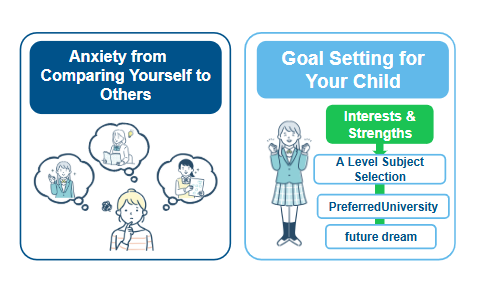
When it comes to your child’s English education, it’s natural to feel anxious about comparing them to others, but I think the important thing is to put that anxiety aside and focus on your child’s own personality and interests.
The purpose of education is not to follow the same path as others, but to build a foundation for children to carve out their own future with their own efforts.
For example, one mother who came to my counseling session was initially anxious to “speak like a native speaker as soon as possible.” However, after seeing her child absorbed in a science experiment, she changed her way of thinking and began to think, “I wonder if I can connect my child’s curiosity to English.” As a result, she found a goal of choosing A-level subjects that specialized in the science field, and her child began to discover the joy of learning the things he loves in English.
By shifting your focus from “comparing with others” to “your child’s growth,” you can establish the basis for your educational choices. Why not start by carefully observing what moves your child?
Why are A-levels attracting attention now? How are they different from Japanese university entrance exams?
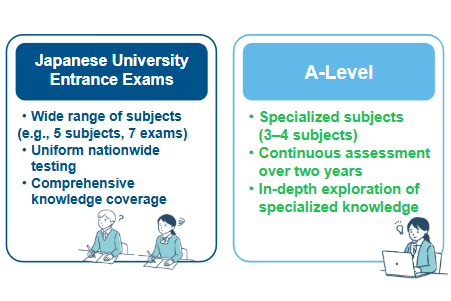
The biggest reason A-levels are now attracting attention from Japanese parents is their educational system, which emphasizes “specialization” and “inquisitiveness,” which differs from the Japanese university entrance examination system. Japanese university entrance examinations require knowledge of a wide range of subjects, regardless of whether the student is in the humanities or sciences. While this is effective in measuring balanced academic ability, it can also make it difficult to find time to study in depth the things that children truly enjoy and are good at.
In contrast, A-Levels are a two-year program that focuses on three or four subjects related to the field your child wants to pursue in the future. For example, if your child wants to become a doctor, they can focus on subjects such as biology, chemistry, and mathematics to build a strong foundation for studying at medical school.
This style of learning, “narrow and deep” rather than “broad and shallow,” maximizes the abilities of students who want to be active on the world stage in a particular field. Universities also highly value students with high A-level scores as “people who are ready to study a specialized field of their own volition.”
International schools aren’t the only option: How to find the right global education for your family
Many people may have the image that “high-quality English education = expensive international schools.” Of course, day-to-day international schools are a great environment, but they are not the only option. Today, there are more flexible ways to incorporate global education that fit into a family’s lifestyle and educational philosophy.
A typical option is an “online international school” like the one we offer at Nisai Japan. When you hear the word “online,” some people may feel anxious about the communication aspect, but in reality, you can connect with students from all over the world through real-time live lessons and learn while experiencing diverse cultures.
The biggest appeal is that you can receive a high-quality Cambridge-accredited education from the comfort of your own home, without having to make big decisions like attending a school or moving abroad. It’s also often more accessible than attending a school, making it a more realistic option to consider. The key is to think outside the box, compare various options, and find the best learning style for your child and your family.
What are A-Levels? An expert explains the international standard for university entrance qualifications
Although the term “A-Levels” is becoming more prevalent, many people are still unfamiliar with the specifics of the system. Here, we will provide a clear explanation of the basics of how A-Levels work and how they are evaluated by universities around the world. Understanding this international university entrance qualification is the first step in expanding your child’s future options globally.
The structure of the A-Level, an international university entrance qualification originating in the UK
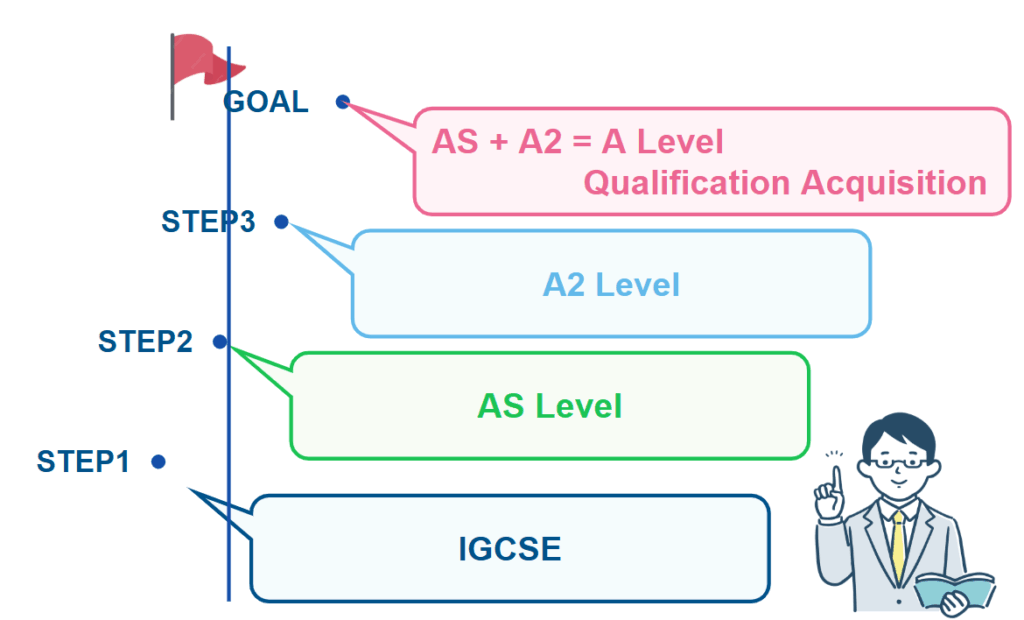
A-Levels (officially known as the General Certificate of Education Advanced Level) are university entrance qualifications based on the British education system, and are widely recognized as a standard for entering universities around the world, particularly top universities in the UK, the US, Australia, and Canada. They are a two-year program taken by students aged 16 to 19, equivalent to the second and third years of high school in Japan.
This two-year program involves an exam at the end of each year, with the first year being called “AS Level” and the second year being called “A2 Level.” Students take exams at the end of each year, and their final A-Level score is calculated by combining the results of these two exams. This gradual assessment system frees students from the pressure of a one-shot exam and allows them to steadily build up their knowledge over the two years.
Universities use A-level scores to determine whether a student has the academic ability and inquisitiveness to keep up with specialized university classes. In other words, achieving high grades in A-levels is like obtaining a reliable passport that opens the doors to the world’s most prestigious universities.
There are about 50 subjects to choose from at A-level! A list of popular and unique subjects
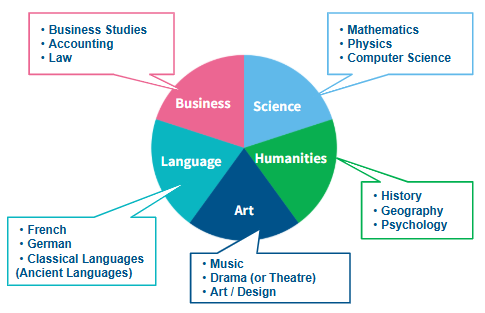
One of the great attractions of Level is the wide range of subject choices available. With approximately 50 different subjects offered, children can choose from a wide range of fields to suit their interests and future career paths. This creates an opportunity for children to explore their own interests and strengths academically, without being bound by a standardized curriculum.
For example, in the science field, the standard subjects of mathematics, physics, and chemistry are of course of course, but in the humanities, more specialized subjects that are closely connected to society, such as history, geography, literature, and even psychology, sociology, economics, and business, are also popular. There is also a wide range of artistic subjects, such as art and design, music, and drama, as well as modern subjects such as computer science and media studies.
With so many options, you’re sure to find a subject that will stimulate your child’s intellectual curiosity. In the next section, we’ll introduce some of the most popular subjects.
Popular core subjects for students aiming for top universities, such as math and science
For students aiming to enter top universities around the world, especially science, engineering, and medical schools, mathematics and science subjects are considered almost mandatory. These subjects are essential for developing the fundamentals of logical thinking and problem-solving skills, which form the foundation for advanced research at university.
Particularly popular are “Mathematics,” “Physics,” “Chemistry,” and “Biology.” These are required for applications to many science faculties. Furthermore, “Further Mathematics,” which teaches more advanced mathematics, is highly recommended for students aiming to enter the engineering or mathematics departments of the most prestigious universities, such as Cambridge and Oxford.
By studying these subjects in depth at A-level, students will not simply memorize knowledge, but will instead gain the ability to understand and apply the principles behind why things happen. Universities believe that this exploratory learning experience is what will prepare students to become promising researchers and engineers of the future.
Specialized subjects directly related to future careers, such as psychology and business
The appeal of A-Levels goes beyond science subjects. For students who want to work in social sciences, business or humanities, there are many highly engaging and specialist subjects available. These subjects will develop practical knowledge and skills that will be directly relevant to their studies at university and beyond.
For example, “Psychology” is a field of study that explores the mechanisms of human behavior and thought, and can lead to a wide range of careers, including counseling, marketing, and human resources. “Business” and “Economics” are essential subjects for understanding the workings of society and corporate activities, and are ideal for children who aspire to become entrepreneurs or financial professionals in the future.
Additionally, if your child is interested in international relations or journalism, “History” and “Sociology” will provide a strong foundation, and if they want to become a lawyer, “Law” will be a good choice. Being able to study these subjects in a specialized capacity starting from high school will be a great help to your child in envisioning their future dreams more concretely and at an early stage.
What is the difference between A-levels and IB (International Baccalaureate)? Which is right for your child?
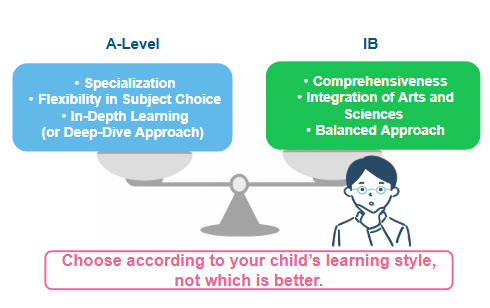
When considering a global education, the IB (International Baccalaureate) is often compared to A-levels. Both are highly regarded university entrance qualifications worldwide, but their educational philosophies are very different. It is important to determine which is best suited to your child.
The biggest difference is that A-levels are “specialized,” while IB is “comprehensive, integrating the humanities and sciences.” At A-levels, students are free to choose three or four subjects that suit their interests and career paths, and delve deeply into them. A-levels are suitable for children who have clear future goals and want to thoroughly explore a specific field.
On the other hand, the IB program requires students to choose subjects from six different fields, and also requires them to write an essay and participate in community service activities. By studying a wide range of fields in a balanced manner, the program aims to cultivate comprehensive intelligence and an international perspective. It is suitable for children who have a strong intellectual curiosity and are interested in a variety of fields.
It is important to consider your child’s personality, learning style, and future goals, and choose a program that will best develop their abilities.
A thorough comparison of the advantages and disadvantages of A-level
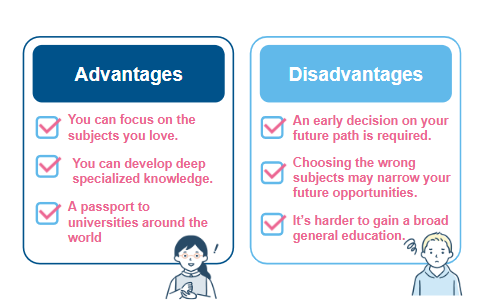
To be realistic about A-levels, it’s essential to understand both the advantages and disadvantages. Here we’ll take an unbiased look at both sides.
meritMaximumThe advantage of is that it allows children to “concentrate on subjects they like.” This allows children to maintain high motivation for learning while acquiring university-level specialized knowledge early on. Furthermore, since it is recognized by many universities around the world, it opens up the door to entering universities abroad. Another attractive feature is that the number of subjects is small, allowing children to take their time to study each subject.
DisadvantagesOn the other hand, because students are required to narrow down their field of specialization at an early stage, choosing subjects can be a difficult decision for children who have not yet decided on their future career path. If their interests change along the way, it is possible that they will not be able to apply to the university of their choice depending on the subjects they choose. Also, compared to the IB, there are fewer opportunities to acquire a broad range of knowledge.
The key to success is to take these points into consideration, discuss them thoroughly with your child, and make a careful decision while also seeking expert advice.
Choose your A-level subjects you won’t regret! 3 points to pave the way for your child’s future
Now that you understand how A-levels work, let’s move on to the all-important topic of subject selection. It’s no exaggeration to say that this choice will have a direct impact on your child’s university admission and future career. Based on our experience supporting many families in choosing subjects, we’ll discuss three important points to keep in mind to avoid regrets, as well as how we at Nisai can help.
Point 1: Consider your future career path and interests (check the requirements of the university you want to attend)
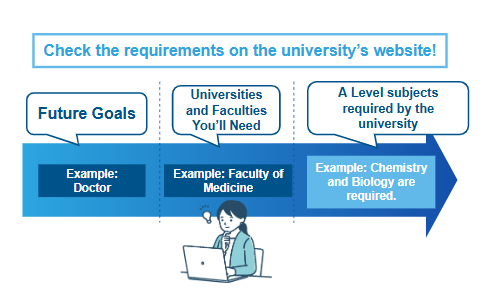
The most basic and important approach to choosing A-level subjects is to work backwards from your child’s future goals. By starting from what field your child wants to go into in the future and what university they want to study at, you will be able to clearly decide which subjects to choose now.
First, parents should discuss with their child the careers and academic fields that they are interested in. Then, once they have selected a few specific university names and faculties, be sure to check the entry requirements on the university’s official website. Many universities specify “Required Subjects” that must be taken at A-level for admission to each faculty, as well as “Recommended Subjects” that are recommended for students to take.
For example, if you want to study engineering at a UK university, mathematics and physics are often required. If you neglect to do this research and spend two years not knowing what the required subjects are, you may be turned away at the application stage. It may take a little effort, but this first step will ensure your child is on the path to achieving their dreams.
Point 2: Choose subjects that make the most of your child’s interests and strengths
Meeting the university entrance requirements is a given, but equally important is whether your child likes and is good at the subject. Studying A-levels is highly specialized, so it is by no means an easy path. In order to maintain high motivation and continue studying for the long period of two years, it is essential that your child has an innate intellectual curiosity and a desire to explore.
What would happen if your child chose a subject that they were not good at simply because it would be advantageous for university? Daily study could become a chore, and as a result, it could become difficult for them to achieve good grades. This would be counterproductive.
Please think carefully about which subjects your child will be able to shine in within the framework of university requirements. The subjects that your child finds truly enjoyable and that naturally make them want to learn more will ultimately lead to the best grades, foster their confidence, and build their future. Think of subject selection as a golden opportunity to respect your child’s individuality and passions.
Point 3: The basic number of subjects is 3 to 4. Recommended combination examples
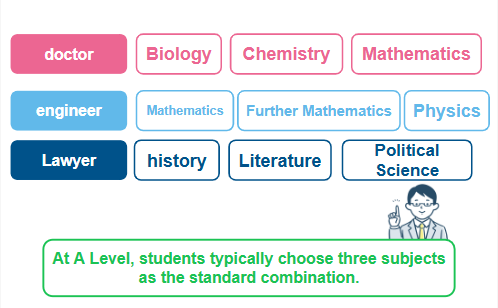
The standard number of subjects chosen for A-levels is generally three. Students who are very confident in their academic ability or who are aiming for a specific course at a top university may choose four subjects, but a realistic and effective strategy is to focus on three subjects first and aim for the highest grade, A* (A star) or A, in each.
There are certain “standard” patterns for combining subjects depending on the career path you are aiming for. Below are some examples for your reference.
- Medicine, Dentistry, and Veterinary Medicine:Chemistry and biology are almost required, and it is common to choose mathematics or physics as the third subject.
- Engineering and Computer Science:Mathematics and Physics are required, and further mathematics and computer science are highly valued.
- Economics and Finance:Mathematics is a must, combining economics, business, and further mathematics.
- Department of Law and Humanities:There are few required courses, but subjects that demonstrate logical thinking and reading comprehension skills, such as history, English literature, political science, and economics, are preferred.
These combinations are just examples. It is important to consider your child’s interests and areas of expertise when deciding on the best combination.
Nisai will support you! The best subject plan for each student
“Even if I work backwards from the future, where do I start?” “I don’t know what combination of subjects is right for my child.” It’s natural to feel anxious about these things. Especially for parents who are only familiar with the Japanese education system, choosing A-level subjects can seem like a complex and difficult task.
Don’t worry. At Nisai Japan, we have many experienced support staff like myself who will fully support you in choosing your subjects. We first have a thorough interview with you and your child to carefully listen to your child’s interests, academic ability, and future dreams. Based on this, and based on our knowledge of the latest admission requirements for universities around the world and our experience guiding many students, we will propose the best subject selection plan for each child.
We don’t just help you choose subjects, we also show you why that combination is good and how you should create a two-year study plan. Don’t worry alone, come talk to us, our experts. Let’s work together to find the path that will maximize your child’s potential.
Can A-levels be used for Japanese university entrance exams? The relationship between A-levels and domestic entrance exams
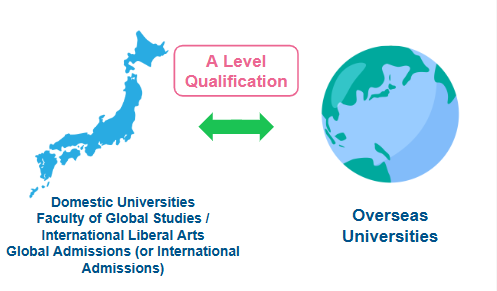
When students start preparing for their A-levels, they often express concern that “if I want to change course and study at a domestic university midway through, won’t that put me at a disadvantage?” The bottom line is that A-level qualifications can be a powerful weapon when applying to Japanese universities.
In recent years, many Japanese universities, especially top private universities such as Waseda University, Keio University, and Sophia University, as well as some national and public universities, have introduced various entrance examination formats, such as “returnee entrance examinations,” “AO entrance examinations,” and “Faculty of International Liberal Arts,” in order to promote globalization. These entrance examinations tend to evaluate not only general academic ability but also activities during high school and high levels of expertise in specific fields.
Achieving high grades at A-levels is not only a test of English proficiency, but also the best evidence of “the spirit of inquiry and expertise gained through in-depth study of a particular field.” In fact, many students have used their A-level qualifications to get into top universities in Japan. Studying A-levels has the potential to create a “double chance,” opening the door to universities not only overseas but also within Japan.
Nisai allows you to study at home! Online international school option
So far, we’ve talked about the appeal of A-Levels and the importance of subject selection, but you may be wondering, “I understand that it’s a wonderful system, but where can my child learn?” The answer to that question is Nisai British International Online School. We’d like to introduce you to a new way of learning that allows children to receive a world-class British education from the comfort of their own home, without the need to commute to school.
Over 25 years of experience! High-quality live lessons by professional native teachers
When choosing an online school, the thing parents are most concerned about is the quality of education. Nisai has a history and track record of over 25 years as a pioneer in online education, and the quality of its education has been recognized by international accreditation organizations (Cambridge International, COBIS, etc.).
Nisai classes are not one-way learning where you simply watch recorded videos. All lessons are real-time “live lessons” taught by experienced, native English-speaking specialist teachers with UK teaching qualifications. Students are in small classes of a maximum of 15 people, and actively participate in lessons while interacting directly with classmates and teachers around the world.
Teachers do not just teach knowledge, but also act as facilitators, listening to what each student has to say, drawing out questions, and encouraging discussion. Through this two-way interaction, students not only improve their English skills, but also naturally develop the communication skills and critical thinking skills that are essential in the international community.
A global environment where students can learn with others from around the world and a support system that caters to each individual student
Nisai’s classrooms are literally open to the world. Students from a variety of countries and cultural backgrounds, including Europe, Asia, the Middle East, and Africa, gather in the same class and learn together. This diverse environment provides your child with the perfect opportunity to develop intercultural understanding.
During class discussions, students realize that things that are taken for granted in Japan are viewed from completely different perspectives in other countries. Through these experiences, students develop flexible thinking that is not bound by stereotypes and a global perspective that accepts diverse values. This is a valuable lesson that was previously thought to be difficult to obtain without physically traveling abroad.
Furthermore, because we are an online school, we are able to provide thorough, attentive support to each student. Learning progress is constantly monitored using data, and if there is any sign of delay, the homeroom teacher or counselor will promptly follow up. We work closely with families to create an environment where children can feel safe and focus on their studies.
A consistent learning path from IGCSE to A-levels, starting from elementary school!
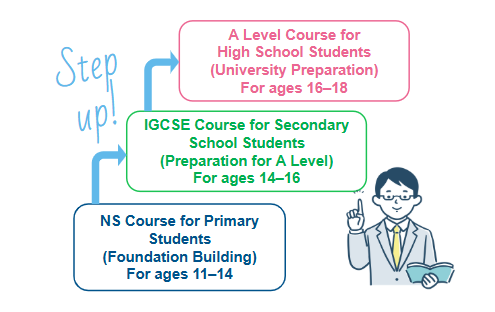
Some people may be interested in A-levels, but think it might be too early for their child. At Nisai, we offer a consistent curriculum that can be started from elementary school age, with an eye toward future A-levels. This allows children to progress smoothly and acquire academic skills up to international standards.
The Primary School Course, aimed at 11 to 14 year olds, provides a solid foundation in academic English by studying English, mathematics, science, and other subjects in English. The subsequent IGCSE Course, aimed at 14 to 16 year olds, is a crucial two-year course that serves as preparation for A-levels. Following the curriculum taught to British middle school students, students learn more specialized content and develop the study skills required for A-levels.
Students who have completed IGCSE then move on to the A-Level course. By learning in a consistent educational program from an early stage, children can smoothly move on to more advanced learning content without being confused by the transition in the curriculum.
What’s the difference between in-person and in-person classes? A thorough comparison of costs and learning styles
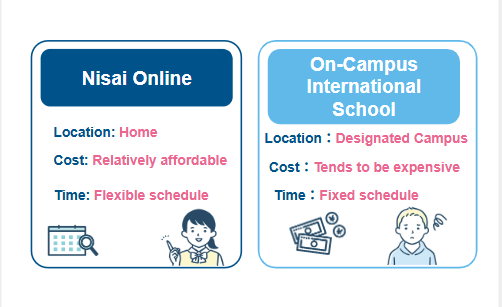
When considering the option of online schools, let’s compare the benefits and specific differences between them and traditional on-campus international schools.
1. Flexibility in location and timeThe biggest advantage is that it can be anywhere. With Nisai, your home becomes an international school, regardless of where you live. You also don’t need to spend time commuting to school, so you can use that time for other lessons, spending time with your family, or preparing and reviewing.
2. FeesGenerally, international schools that require students to attend classes on a day-to-day basis require annual tuition fees of several million yen, as well as costs for facilities and teaching materials. Because Nisai does not have a physical school building, it is able to significantly reduce these costs, enabling it to provide high-quality international education to more people.
3. Learning StyleNisai’s online learning is also a great opportunity to develop self-management skills. Logging in on time and planning your assignments are important skills that will be useful even after you enter university or work. Of course, we also have a comprehensive support system in place to help you achieve this.
Taking all these points into consideration, online international schools are a very rational and effective option that suits the diverse lifestyles of today.
What are your career options after obtaining your A-levels? Paths to top universities both in Japan and overseas
Studying A-levels is not an end in itself. It is an important step towards your child’s dream of entering the university and achieving a brilliant career. Here, we will introduce the specific career paths that students who have achieved A-levels actually have in mind. We hope you will get a sense of how the passport of A-levels can open doors to a wider world.
A-level scores recognized by universities around the world: the path to Cambridge and Oxford
A-levels are the qualifications most highly regarded by universities in the UK, where they originated. Of course, the world’s top universities, such as Cambridge and Oxford, are no exception. When applying to these universities, A-level scores are the most important indicator for determining whether or not you are accepted.
For example, in the science department at Cambridge University,AIt requires very high academic ability, such as an “A” (highest grade or equivalent) in three subjects, but because the goal is clear, it is easy to prepare for it. Every year, many students from Nisai go on to study at these top British universities (Russell Group).
Furthermore, A-level scores are recognized as official admission qualifications not only in the UK but also by prestigious universities around the world, including Ivy League universities in the US, as well as in Canada, Australia, Singapore, and Hong Kong. No matter where in the world your child wants to study at a university, A-level scores will serve as a powerful certificate to support their dreams.
Famous Japanese universities where you can take A-level exams and their entrance examination methods
As mentioned above, A-levels are not just for overseas universities. Universities that are leading the way in globalization in Japan also actively accept A-level holders. In particular, faculties where degrees can be obtained entirely through classes taught in English (such as Waseda University’s Faculty of International Liberal Studies, Sophia University’s Faculty of International Liberal Studies, and International Christian University (ICU)) directly recognize A-level scores as eligibility for application.
These entrance exams are often decided by document screening and interviews, and do not require academic exams like those required for general Japanese university entrance exams. Having high grades in A-levels is a great advantage, as it demonstrates both English proficiency and expertise.
Recently, an increasing number of universities, even in traditional flagship faculties such as the Faculty of Law and Faculty of Economics, are setting up special entrance exams for students with international qualifications such as A-levels. Studying A-levels can be seen as a strategic choice, allowing your child to carefully consider the best career path for them, weighing the pros and cons of top universities both overseas and domestically.
A-Levels open up career possibilities as seen through graduates’ experiences
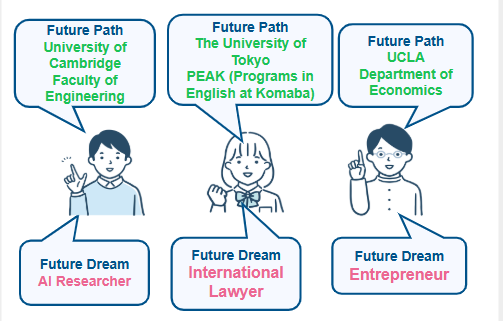
Ultimately, what matters is your child’s career beyond university – how they will thrive in society – and A-Levels provide a strong foundation for this.
Nisai graduates have gone on to study at universities around the world and are active in a wide variety of fields. For example, one graduate who mastered mathematics and physics at A-level and went on to study computer science at Cambridge University is now at the forefront of AI development at a global IT company. Another graduate who studied history and economics at the London School of Economics and Political Science has realized his dream of working for an international organization.
They all say, “The experience of delving deeply into a particular field at A-Levels has nurtured the inquisitiveness and logical thinking skills that are essential for university research and their current jobs.” A-Levels are not simply studying for university entrance exams. They are an education that develops the “ability to think” that will enable children to continue learning throughout their lives and contribute to society.
What you can do at home now to help your child reach their full potential
So far, we’ve talked about the appeal of A-levels and how to study them in detail. What do you think? We hope that it has inspired you to take a new step towards your child’s bright future. Finally, we’d like to share three important things you can start doing at home right now to prepare for this big challenge. As experts and as parents, we wholeheartedly support you as you make your start.
First, make time to talk about the future with your child.
It all starts with a conversation between parent and child. It may be a little embarrassing, but please try to find time to talk with your child about topics such as “What would you like to do in the future?” and “What are you most interested in?” At this time, it is most important to first listen carefully to what your child has to say, rather than unilaterally conveying your own wishes.
Your child may not yet have a clear answer. That’s perfectly fine. What’s important is the process of thinking about the future together as a parent and child. The most important support you can provide at home is to help your child discover their own interests and concerns through dialogue, and to create an opportunity for them to talk about their dreams for the future in their own words.
If your child says something like, “I’d like to study this at a university abroad,” don’t dismiss it; respond positively by saying, “That’s great! Let’s find out together how to make it happen.” That one word can be a big step for your child.
Setting goals to aim for and creating a reasonable study plan
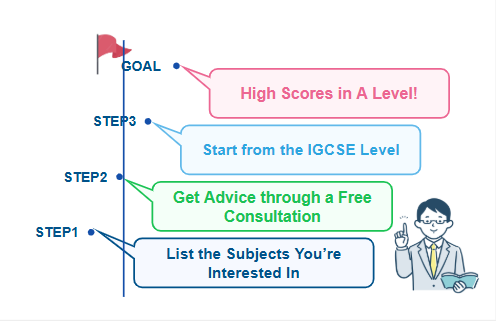
Once you have a clear vision of your future dreams, the next step is to break them down into specific goals. Rather than immediately setting a big goal like “getting an A* at A-level,” the key to success is to work backwards from there and break it down into small, achievable steps.
For example, set specific, achievable short-term goals such as, “Let’s start by making a list of three A-level subjects that you’re interested in together as a parent and child,” “Let’s try to attend an online school information session by the end of next month,” or “Let’s try to solve one IGCSE-level maths workbook during the summer holidays.”
Accumulating small successes one by one will increase your child’s confidence and motivation to study. When making a study plan, be sure to avoid creating an unreasonable schedule and ensure that there is time for rest and doing the things you enjoy. The most important thing is to make a long-term plan that parents and children can continue while having fun.
If you have any concerns, please consult with Nisai’s support staff (free individual consultation)
Even if parents and children discuss and set goals, they will still have questions and anxieties that cannot be resolved without specialized knowledge. “Is this subject selection really the right one?” “Will my child be able to keep up with the classes with their current English ability?” If you have such concerns, please don’t bear them alone.
At Nisai Japan, we offer free individual consultations at any time to answer any concerns or questions you may have. Our experienced support staff will listen carefully to what you have to say and provide the best advice tailored to your child’s situation.
Please rest assured that even if you receive a private consultation, we will not strongly recommend that you enroll in our school. Please feel free to use this as a place to gather information first. We look forward to hearing from you. Let’s work together to open the door to your child’s bright future.
【summary】
This time, we explained the importance and specific steps for choosing subjects for A-Levels, an international university entrance qualification. A-Levels offer a wide variety of approximately 50 subjects, and their greatest feature is that students can choose three or four that match their child’s interests and future dreams, deepening their specialization. There are three key points to choosing subjects you won’t regret: 1) work backwards from their future career path, 2) utilize your child’s interests and strengths, and 3) use standard combinations as a guide. Finding the optimal subject plan for your child, with expert advice, is the first step to opening the door to the world, whether through a traditional international school or an online school like Nisai.
FAQ
-
Are A-Levels recognised as a qualification for university admission?
-
Yes, it is a qualification for university admission that is widely recognized worldwide. It is adopted as an official qualification for admission by many universities in Europe and Asia, especially in English-speaking countries such as the UK, the US, Canada, and Australia. Even in Japanese universities, the number of cases where A-level grades are evaluated in international faculties and AO/recommendation entrance exams is increasing year by year. For more details, please see the "What are your career options after obtaining your A-levels? Paths to top universities both in Japan and overseasSee also the " section.
-
How difficult is the A level?
-
A-Level is more specialized than the content taught in Japanese high schools, and covers content equivalent to the general education level of universities, so it can be said to be academically difficult. However, since it involves focusing on three or four subjects and studying them thoroughly over two years, if you choose subjects that match your child's interests and areas of expertise, it is possible to work with high motivation. The perceived difficulty will vary greatly depending on the subjects chosen. Finding the right subjects for your child is the key to their academic success.
-
How many subjects do students usually take?
-
Typically, students choose three subjects, which is the most common pattern. The goal is to achieve the required grades for their desired university with these three subjects.
Some students aiming for top-tier universities or those who are very confident in their academic abilities may take four subjects to broaden their options. However, taking more subjects also increases the workload, so careful consideration is essential.
We recommend starting by selecting three subjects, based on the key points explained in “How to Choose A-Level Subjects Without Regret: 3 Key Tips to Shape Your Child’s Future.”
-
Can I keep up with A-level classes even if my English skills are not yet sufficient?
-
Don't worry. At Nisai, we offer preparatory courses tailored to your child's current English ability before they begin A-level classes. For example, we offer English courses based on the international standard CEFR, or IGCSE courses, which are the preparatory course for A-level classes, to intensively improve the academic English skills required for class. Perfect English ability is not required from the start. As long as your child has the desire to learn, our experts will fully support them until they are able to participate in class smoothly.
-
How much does it cost to study A-Levels?
-
Costs vary greatly depending on the learning environment. Attending an international school typically costs more than 2 to 3 million yen per year. On the other hand, online international schools like Nisai can significantly reduce costs because they do not require physical school buildings or facilities. Specific costs will vary depending on the number of subjects and courses selected, so please feel free to contact us for an individual consultation.
-
When is the ideal time to start studying for A-levels?
-
The A-level program itself generally begins in Year 12 (equivalent to second year of high school in the UK). Therefore, ideally, students would be able to transition smoothly to A-level studies by starting preparation from the previous stage, IGCSE (equivalent to third year of junior high school to first year of high school). At Nisai, we offer a consistent curriculum starting from elementary school courses, so we can suggest the optimal start time based on your child's age and English ability.
-
Is it possible to change my subject selection midway through the course?
-
While it is not impossible to change subjects once A-level studies have begun, it is not recommended. A-levels are a curriculum that builds up over two years, so if you change subjects midway through, it will be extremely difficult to catch up on your learning. This is why choosing subjects before starting your studies is more important than anything else. To avoid any regrets, it is important to consult thoroughly with an expert in advance and determine the best subjects for your child.
-
As a parent, do I need to have a high level of English proficiency?
-
Please rest assured that parents themselves do not necessarily need to have a high level of English proficiency. At Nisai Japan, we have Japanese support staff on-site, and all interviews, consultations, and procedures with parents are conducted in Japanese. We have a system in place to immerse children in an English-speaking environment while providing solid support to families in Japanese, so even parents who are worried about their English proficiency will have no problems.