- International school
- 2026.5.11
“I Don’t Want to Go to School.” What Your Child May Really Be Trying to Tell You
“I Don’t Want to Go to School” — A Sign from Your Child? For Parents Struggling in Singapore
Seeing your child in tears every morning, saying “I don’t want to go to school,” can be heartbreaking. Faced with the uncertainty of what lies ahead, you may often find yourself thinking, “Will everything really be okay?” Please don’t blame yourself. Especially here in Singapore, many families are facing the same struggles you are.
In this article, we’ll explore the possible reasons behind your child’s signals, and share the first steps you can take as a parent to support them with the right mindset.
Is It Just My Child? Educational Challenges Many Expat Families Face
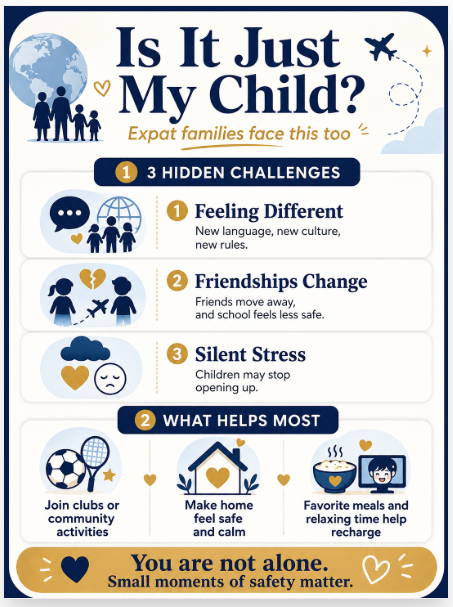
You may have thought, “In an international environment, children will naturally adapt.” But when things don’t go smoothly, it’s easy to wonder, “Is my child the only one who doesn’t fit in here?” Please know—you’re not alone. Many expat families encounter these invisible walls.
One of the biggest challenges is the instability of friendships. A child may finally bond with a close friend, only to lose them suddenly when the family moves back home. After experiencing this several times, children may become hesitant to form deep connections, and school stops feeling like a safe place where they belong.
But friendships at school aren’t everything. For example, joining sports teams or extracurricular activities run by the Japanese community can help children make friends across schools and nationalities, giving them a broader world. And no matter how tough things get outside, creating a home where your child feels “safe once I’m back” makes a huge difference.
You don’t need to force conversations about school. Simply cooking your child’s favorite meal, or watching their favorite anime together, can recharge their emotional batteries.
Three Psychological Signs Behind “I Don’t Want to Go to School”
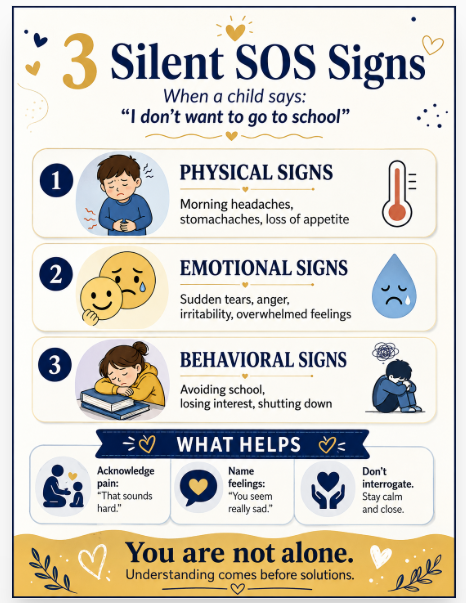
Children can’t always articulate the real reasons behind “I hate school.” Instead, they express it through changes in body, emotions, or behavior—sending you their silent SOS.
A common sign is recurring headaches or stomachaches that appear in the morning. These are not “excuses”—they may be psychosomatic symptoms caused by stress. Emotional swings at home, like sudden anger or tears, can also be a sign. This is often how children release the tension they’ve bottled up at school, in the only place they feel safe—their home.
When your child says “My stomach hurts,” don’t respond with “Again?” Instead, acknowledge: “I see, it hurts. That must be tough.” That acceptance is often the first step toward hearing the real story: “Actually, at school…”
When emotions overwhelm your child, avoid interrogating them. Instead, put their feelings into words for them: “Something must have made you feel really sad.” This kind of emotional “translation” helps them calm down and start regaining control.
Don’t Blame Yourself — What Parents Should Keep in Mind First
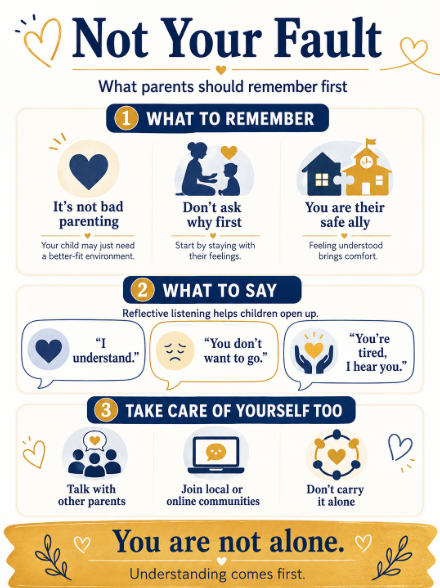
When a child consistently resists going to school, many mothers think, “Is it my parenting?” or “Should I have been stricter?” But please remember—this is not your fault.
Your child’s struggles are not a reflection of your parenting, but often a sign that “the current environment just doesn’t fit.”
That’s why the first thing to practice is not asking why, but simply being with your child’s feelings. If they say, “I don’t want to go,” the best response is: “I understand. You don’t want to go.” Just being their safe ally can bring enormous comfort.
Try reflective listening—mirroring your child’s words without judgment. If your child says, “I’m tired,” you can respond with: “You’re tired, I hear you.” No advice, no evaluation—just reflection. This alone helps your child feel understood and more willing to open up.
And don’t forget your own emotional care. Join local Japanese parent groups or online communities in Singapore. Talking with others who understand helps you avoid carrying the burden alone.
The Background of School Refusal and Solutions – Exploring School Options in Singapore
Once you’ve acknowledged your child’s signals and shown empathy, the next step is to broaden your perspective. Why does your child feel that “school isn’t a good fit”? Here, we’ll look at the issue through the lens of a mismatch between your child and their school environment. We’ll also explore the characteristics of Japanese schools, local schools, and international schools in Singapore, and consider why an international school may provide a positive solution for your child.
Why the Current School Doesn’t Feel Right – Mismatch in Learning Style and Environment
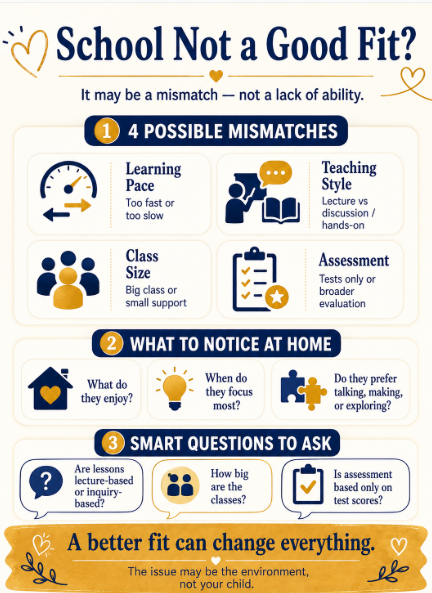
You may sometimes wonder, “Maybe my child just isn’t good at studying…” but in many cases, the issue is not ability—it’s the fit between your child and the school’s learning style or environment.
For example, lecture-based lessons may work well for some students, but others quickly lose focus. On the other hand, some children thrive when they can discuss in groups or learn through hands-on, inquiry-based approaches. Class size is another important factor: a shy child may get lost in a large classroom but suddenly come alive when moved into a smaller, more supportive environment.
By observing what your child enjoys and gets absorbed in at home, you can discover clues about their preferred learning style—valuable insights for choosing a school. When visiting schools, asking questions like “Is assessment based only on test results?” can also reveal what values and priorities underpin their educational philosophy.
Local Schools, International Schools, and the Japanese School – Key Features of Singapore’s Education Options
When choosing a school in Singapore, families generally consider these three main pathways. By understanding the advantages and challenges of each, you can carefully weigh which environment best fits your child’s personality and your family’s long-term goals.
Three School Options in Singapore
| Type of School | Features & Advantages |
| Japanese School | Provides education based on the Japanese national curriculum, offering the greatest peace of mind for families. For those planning to return to Japan in the future, this is often the most reliable choice. |
| Local Schools | Renowned for world-class academic standards and relatively affordable tuition fees. Students can acquire both English and Chinese, but the academic competition is intense and may come with significant pressure. |
| International Schools | Home to students and teachers from a wide range of nationalities, fostering a culture where “everyone is different, and that’s normal.” Many schools emphasize individuality and provide an environment where children can learn and grow freely. |
Choosing the right school ultimately comes down to whether it suits your child’s personality, but it’s equally important to think in reverse from their future path. If your child is aiming for a university overseas, an international school may provide the best preparation. If a Japanese university is the goal, a Japanese school may give them a clear advantage.
Also, keep in mind that there are “hidden costs” beyond tuition—such as facility fees—so it’s wise to confirm the total annual cost in advance for peace of mind.
Steps to Try Before Considering a Transfer – Improving Communication with the Current School
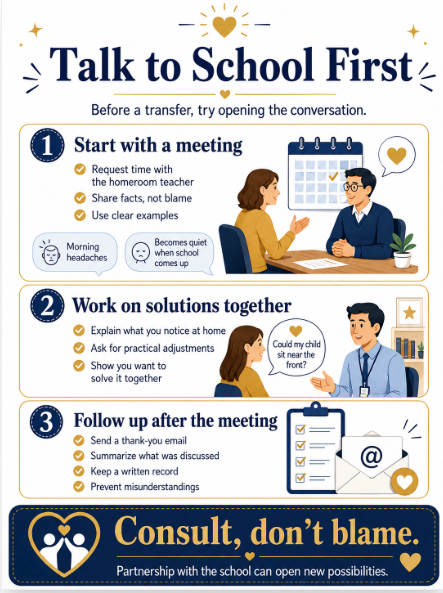
Transferring schools is a major decision. Before taking that step, it’s worth giving your current school another chance—you may still find new possibilities by opening dialogue. What matters most is approaching the school with a mindset of consulting rather than blaming.
Start by requesting a meeting with the homeroom teacher and share specific observations about your child at home. Instead of saying simply, “My child doesn’t want to go to school,” describe objective facts such as, “Every morning, they complain of headaches,” or “When we bring up school, they become silent.” By sharing clear examples, the teacher is more likely to take the situation seriously.
From there, propose concrete adjustments, like: “If possible, could my child sit at the front of the classroom?” Demonstrating that you are actively seeking solutions encourages the school to work with you.
After the meeting, follow up with an email summarizing the discussion and expressing your gratitude. This not only prevents misunderstandings but also creates a written record of what was agreed upon.
Why International Schools Can Be a Solution for School Refusal
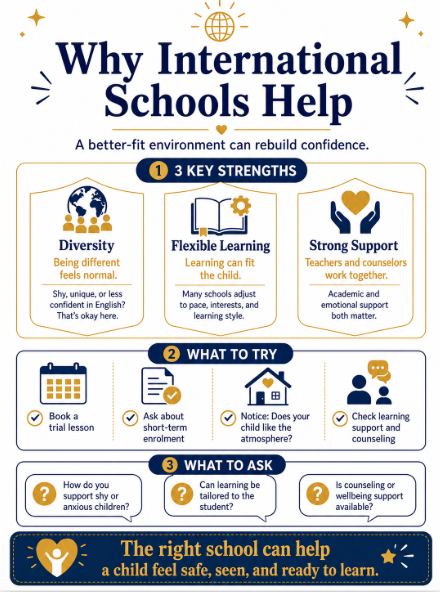
If improvement isn’t seen at the current school, transferring to an international school has the potential to transform your child’s situation. The biggest reason is the deeply rooted culture of diversity. In an environment where students come from all over the world, things like weaker English skills or a shy personality are seen as just another part of individuality. Children don’t have to conform to being “the same as everyone else,” which helps them feel safe being themselves and rebuild self-confidence.
Another strength is the flexible, personalized approach to learning. Instead of rigid, one-size-fits-all lessons, many schools adapt to each student’s pace and interests.
It’s highly recommended to take advantage of trial lessons or short-term enrollment options. The best indicator is whether your child feels, “I like the atmosphere here.” Also, during the admissions process, be sure to ask about the availability of learning support staff and counselors who can provide mental health care.
Finding the Right Environment for Your Child Practical Steps for Choosing the Right International School
Once you’ve identified international schools as a possible option, the next step is to take concrete action. With so many schools in Singapore, it’s understandable to feel unsure about where to start. Don’t worry — in this section, we’ll outline specific steps and checkpoints to help you find the best possible school for your child. We’ll also introduce a new and increasingly popular alternative: online international schools, which allow students to study without the pressure of daily commuting.
How to Choose Without Regret. Five Key Points to Check During a School Visit
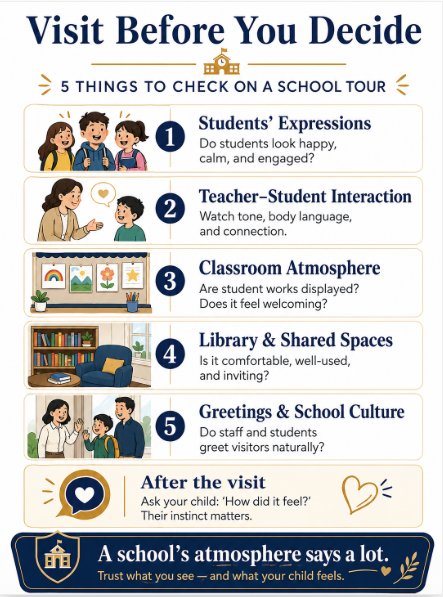
The most important step in choosing a school is to actually visit it. A school tour lets you sense the atmosphere that can’t be conveyed through brochures or websites.
Rather than walking around aimlessly, it’s helpful to have a clear checklist in mind.
The first thing to observe is the expressions on students’ faces. How they look and behave says a lot about their satisfaction with the school. Also, pay attention to how teachers communicate with students — their tone, body language, and the distance between them.
Don’t limit your observations to the admissions officer giving you the tour. Look around at how other teachers and staff interact in the hallways. A school where everyone greets you warmly tends to have a positive and open culture.
After the visit, gently ask your child how they felt about the school. Their intuition often provides the most valuable insight.
Why You Shouldn’t Judge Schools by Tuition Alone? What to Compare When Choosing an International School in Singapore?
International school tuition in Singapore is far from cheap, so it’s natural to focus on cost. However, choosing based only on tuition can lead to disappointment.
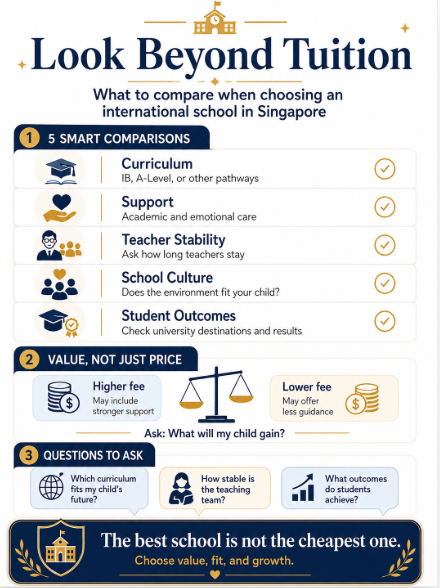
The key is to evaluate the overall value — what kind of education, care, and growth your child will gain in return for the tuition you pay.
For example, School A may charge higher fees but offer extensive support, while School B may be cheaper but lack proper academic guidance. Which would be the better investment for your child?
The curriculum also matters greatly. Whether your child plans to attend a university overseas or in Japan will influence which program — IB, A-Level, or otherwise — is most suitable.
During your visit, it’s a good idea to ask, “How long do your teachers typically stay?” Schools with long-term, experienced teachers often provide more stable and high-quality education. Checking graduates’ university destinations is another good indicator of academic results.
Ultimately, you should consider not only tuition but also curriculum quality, teacher stability, school culture, and student outcomes before making a decision.
A New Way to Learn. The Benefits of Online International Schools That Remove Commuting Pressure
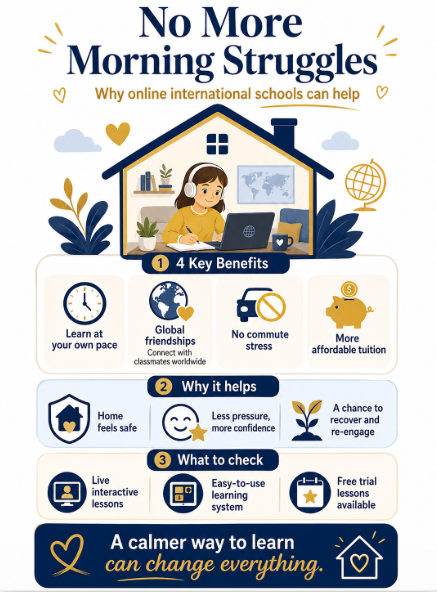
For some children, simply going to school every day can be an overwhelming source of stress. In such cases, an online international school can be an effective and liberating alternative.
It frees families from the exhausting morning battles of “Go to school!” versus “I don’t want to go,” and allows children to learn from the comfort of home — their safest environment.
For those who have struggled socially or emotionally, online learning can also serve as a period of recovery, helping them regain confidence and motivation. Additionally, connecting with classmates from all over the world fosters a truly global perspective that traditional schooling can’t always provide.
Because online schools don’t need to maintain physical facilities, their tuition fees are often much more affordable.
When considering an online school, check whether it offers live, interactive lessons and whether the system is engaging and easy for your child to use. Many offer free trial lessons, which are a great way to experience the program firsthand.
Nisai — A British Curriculum Online School with Strong Support
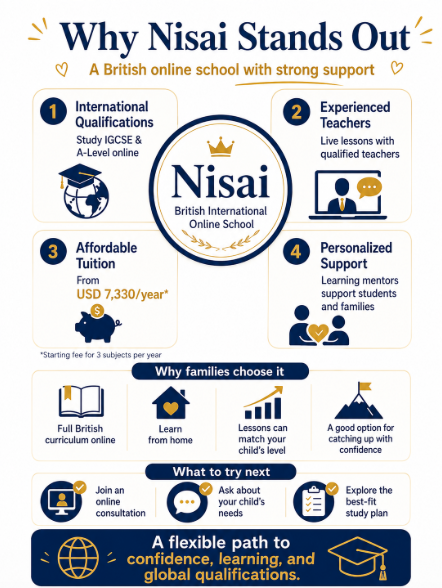
Among various online schools, Nisai British International Online School stands out for delivering a full British curriculum entirely online.
Its biggest advantage is that students can earn international qualifications such as IGCSE and A-Level from home, opening doors to universities around the world.
All classes are live, interactive sessions taught by experienced professionals who monitor each student’s understanding, ensuring a high-quality learning experience.
Each student is also assigned a learning mentor who provides academic guidance as well as emotional support, helping children regain confidence and develop positive learning habits.
Despite its strong support system, Nisai’s tuition starts at USD 7,330 for three subjects per year, making it far more affordable than most international schools in Singapore.
Since lessons can be tailored to each student’s academic level, it’s also ideal for catching up on missed learning. If you’re unsure whether Nisai is right for your child, consider attending one of their online consultation sessions to discuss your child’s needs in detail.
Start by Talking to a Professional Relieve Your Anxiety Through a Personal Consultation

Even after exploring different options, it’s natural to still feel uncertain — unsure which information to trust or which path is truly best for your child. In such moments, it’s important not to handle everything on your own.
Consulting an education specialist or a counselor experienced in supporting school-refusing children can make a world of difference.
Professionals can objectively assess your child’s situation, outline realistic options, and clarify the pros and cons of each choice. Just speaking openly about your concerns often helps lighten the emotional load and bring clarity.
Remember, there are many types of counselors, and compatibility matters. If the first person doesn’t feel right, don’t give up — try speaking with several experts. By doing so, you’ll eventually find someone you can truly trust and rely on.
▶▶▶Private consulation(online booking)
Regaining Your Child’s Smile and Confidence — The Bright Future That Awaits in a New Learning Environment
Up to this point, we’ve explored the reasons why children may resist going to school and examined concrete steps for choosing a new educational setting.
In this final section, let’s look at the bright future that awaits when you find an environment that truly suits your child.
You may feel anxious and uncertain right now, but this one step can become a major turning point—one that helps your child regain both their smile and confidence.
Keep hope in your heart as you read on.
Building Self-Esteem and Motivation Through Learning in the Right Environment

The biggest reason for this transformation is the recovery of self-esteem.
For example, in small classes or online programs where students can learn at their own pace, children begin to feel safe—“It’s okay to ask questions,” and “It’s okay to make mistakes.”
As they accumulate small moments of “I understood!” success, a sense of “I can do it too” begins to grow.
This newfound confidence directly fuels their motivation to learn.
What used to feel like forced studying becomes linked to their interests and strengths, evolving into a natural curiosity to explore — “I want to know more,” “I want to learn more.”
The moment a child’s innate curiosity shines again, sparked by the right environment, is invaluable.
It becomes a lifelong asset—far more meaningful than any test score.
Lessons from Families Who Overcame School Refusal
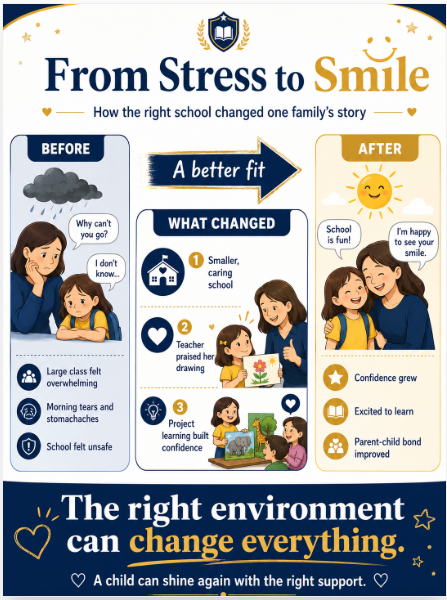
Here’s a real example (fictionalized to protect privacy) of a family whose situation improved after transferring to an international school.
A fourth grader, A-chan, struggled to fit into a large class and began crying each morning with stomachaches, refusing to go to school.
After much deliberation, her mother decided to transfer her to a small international school known for its personalized care.
At first, A-chan was nervous, but when her teacher praised one of her drawings and introduced it to the class, she began regaining confidence little by little.
Later, she became deeply engaged in a project-based assignment researching her favorite animal. When she presented her findings, classmates eagerly asked questions — a moment that boosted her confidence immensely.
Today, A-chan goes to school every day with excitement.
Her mother reflects, “Back then, our conversations were strained. Now, hearing her happily talk about school is my greatest joy. I truly believe transferring was the right decision.”
As this story shows, changing environments can sometimes strengthen the parent-child relationship itself.
The Benefits of Global Education That Expand Your Child’s Future Potential
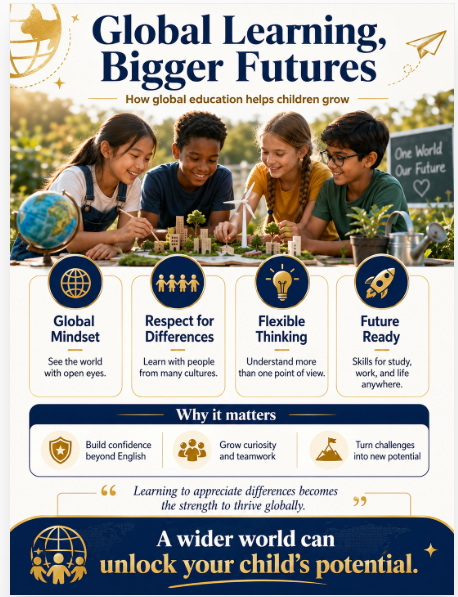
The long-term benefits of studying at an international school or a globally connected online school go far beyond simply learning English.
The greatest gift lies in developing a global mindset and flexible thinking, nurtured through daily exposure to diverse cultures and values.
Working together with peers who look, speak, and think differently teaches children not to fear differences, but to respect and embrace them with curiosity.
This mindset becomes a powerful asset for navigating an increasingly complex and fast-changing world—no matter what career path they choose.
They also learn that Japan’s “common sense” isn’t the world’s only perspective, helping them cultivate the ability to see from multiple angles.
Whether your child studies abroad or works internationally in the future, this broader worldview becomes a tremendous advantage — even within Japan itself.
In this way, a once-painful experience of school refusal can ultimately become a gateway to unlocking your child’s full potential.
Summary
In this article, we’ve guided parents in Singapore who are facing their child’s school refusal — from identifying the causes to exploring concrete solutions.
A child’s “I don’t want to go to school” is not stubbornness, but a heartfelt SOS.
Please start by acknowledging that feeling, and don’t blame yourself.
If you feel that your child’s current school isn’t the right fit, remember that Singapore offers a range of alternatives — including international schools and online programs.
What matters most is finding an environment that truly matches your child’s personality and learning style, not just tuition fees or reputation.
Refer to the school selection tips shared in this article — including new models like Nisai’s British curriculum with strong individualized support — and take the first step forward.
Don’t hesitate to consult professionals; you don’t have to face this alone.
Your action today can be the most reliable step toward bringing back your child’s smile and confidence.
FAQ
-
My child’s English level isn’t strong yet. Can they still enter an international school?
-
Yes. Many international schools offer English support classes (EAL/ESL) for non-native speakers, so perfect fluency isn’t required for admission.
Depending on the school, there may be different levels of support or intensive courses.
Since requirements vary, it’s best to contact each school directly to learn about their English language support options.
-
My child has missed classes due to school refusal. Can they catch up academically?
-
Yes, it’s absolutely possible.
By choosing a school that provides individualized learning plans or a flexible, mastery-based online program, your child can efficiently recover at their own pace.
For instance, as introduced in “Features and Comprehensive Support of Nisai’s British Curriculum You Can Learn from Home,” such environments allow children to rebuild their foundation without pressure — the fastest way to regain confidence.
-
Won’t my child struggle to make friends or develop social skills in an online school?
-
That’s a common concern, but many online schools address it effectively.
Live group lessons, discussions, and virtual clubs offer meaningful opportunities for students to interact and build teamwork skills.
As discussed in “A New Way of Learning Free from Attendance Pressure: The Online School Option,” connecting with peers worldwide fosters social development in a unique and valuable way.
-
How does Nisai’s tuition compare with other international schools in Singapore?
-
Typical international schools in Singapore charge SGD 30,000–50,000 (about JPY 3.45–5.75 million) per year.
In contrast, Nisai — being fully online — offers programs starting at USD 7,330 (about JPY 1.1 million) for three subjects annually, significantly reducing costs due to the lack of physical campus expenses.
-
I’m not ready to decide on transferring yet. Where should I start?
-
There’s no need to rush.
Start by referring to “Steps to Improve Communication with Your Child’s Current School Before Considering Transfer.”
Talk to your child’s teachers or counselors first.
At the same time, join online information sessions for schools you’re interested in or use free consultations with educational advisors.
Having multiple options will help you feel more at ease and make a more confident decision.