
- International school
- 2026.3.11
A successful Singapore education migration: The optimal solution for a prestigious international school in the central area and “online combined use”
The appeal of Singapore as a study abroad destination: Global education programs
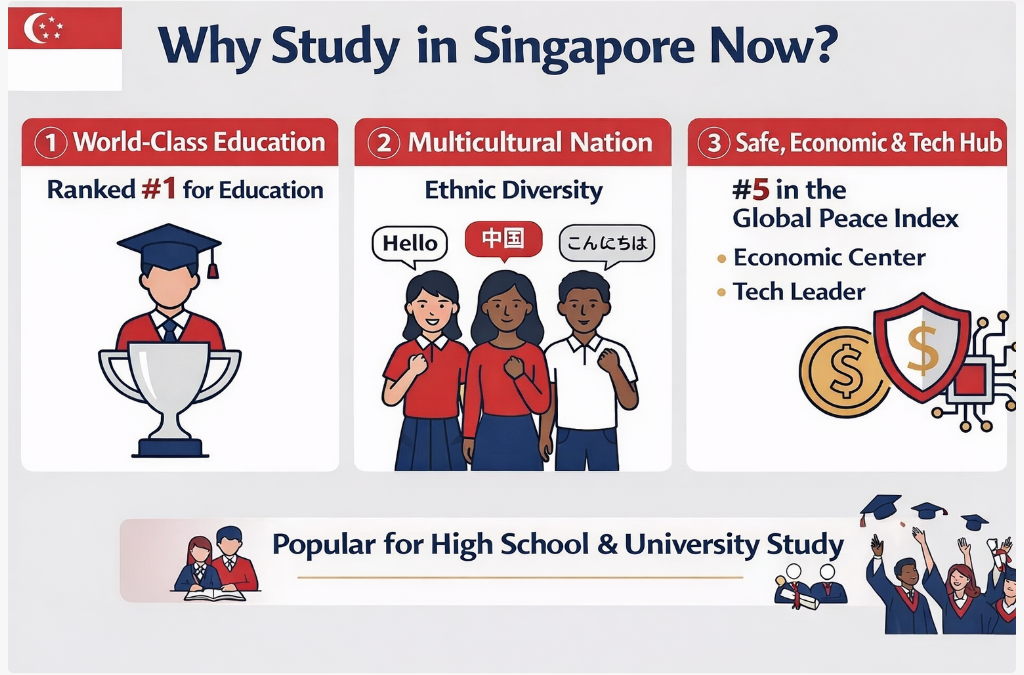
Singapore is a popular study abroad destination in Asia, boasting world-class educational standards and safety. The official languages of Singapore are Malay, Tamil, English, and Chinese, with Chinese and English being particularly widely spoken in the city.
Singapore is a multi-ethnic country, with over 70% of its population being Chinese, followed by Malay and Indian, making it one of the countries with a diverse mix of races and ethnicities. As a multi-ethnic country, Singapore is particularly focused on economic development and the strengthening and improvement of technology within Asia.
The university has attracted attention from around the world for its education, and its global education programs, which combine high-quality education with multicultural coexistence, are particularly popular.
Many international schools offer an internationally recognized education centered on English, such as the British style or the International Baccalaureate (IB).In addition, as Singapore is a multi-ethnic country, students can naturally develop an understanding of the differences in ideas and values of other cultures in a multilingual environment while studying English.
With a good educational environment and very good public safety, Singapore is a popular destination for international students, especially at the high school and university levels. Partnership programs with prestigious European universities and exchange programs with the internationally renowned National University of Singapore (NUS) are also popular, and the country is ranked highly in the world.
Comparison with Japan: Are the costs of living and safety high?

Living costs in Singapore tend to be significantly higher than in Japan. Prices are high, and even in places where rent and other housing costs are cheap, it costs around 300,000 yen in Japanese yen. Living costs are about 1.5 to 2 times higher than in Japan. When it comes to food costs, you can keep living costs down by saving money by using cheap food courts and cooking at home instead of eating out.
On the other hand, Singapore is also known as a safe and easy country to live in. It was ranked 5th in the world in the 2024 Global Peace Index, and there are security cameras installed everywhere in the city and strict laws against littering. However, as a crime prevention measure, it is still necessary to keep your valuables safe and pay attention to your surroundings. It is also important to be careful of petty crimes that tourists are prone to, such as pickpocketing and purse snatching.
Since there is a possibility of encountering trouble even at night, it is important to practice basic crisis management, such as choosing areas with a lot of people when going out, using a car scrapping service, and carrying a security alarm instead of earphones.
What are the English education rankings and how easy is it to obtain a student visa?

The EF EPI English Proficiency Index surveys the English proficiency of non-native English-speaking adults around the world every year and ranks them by country. In the 2024 edition, 2.1 million people from 116 countries and regions participated, and Singapore ranked third overall.
In addition, Singapore’s public education is highly regarded internationally, and in the 2022 edition of the Organisation for Economic Co-operation and Development’s (OECD) Programme for International Student Assessment (PISA), which is conducted every three years, the country ranked first in the world in mathematics, science and reading, despite the significant impact of the COVID-19 pandemic on education.
It seems that student visas (Student’s Pass) are easy to obtain. Full-time students must apply in advance through an online system called SOLAR (Student’s Pass On-Line Application & Registration) before entering the country. You need to log in to SOLAR using the application number printed on the admission certificate issued by your school and apply for a Student Pass.
Student visa details in Japanese (JASSO)Here
The Singapore government’s student visa application website (English)Here
Prestigious international high schools in Singapore: scholarships and admission requirements
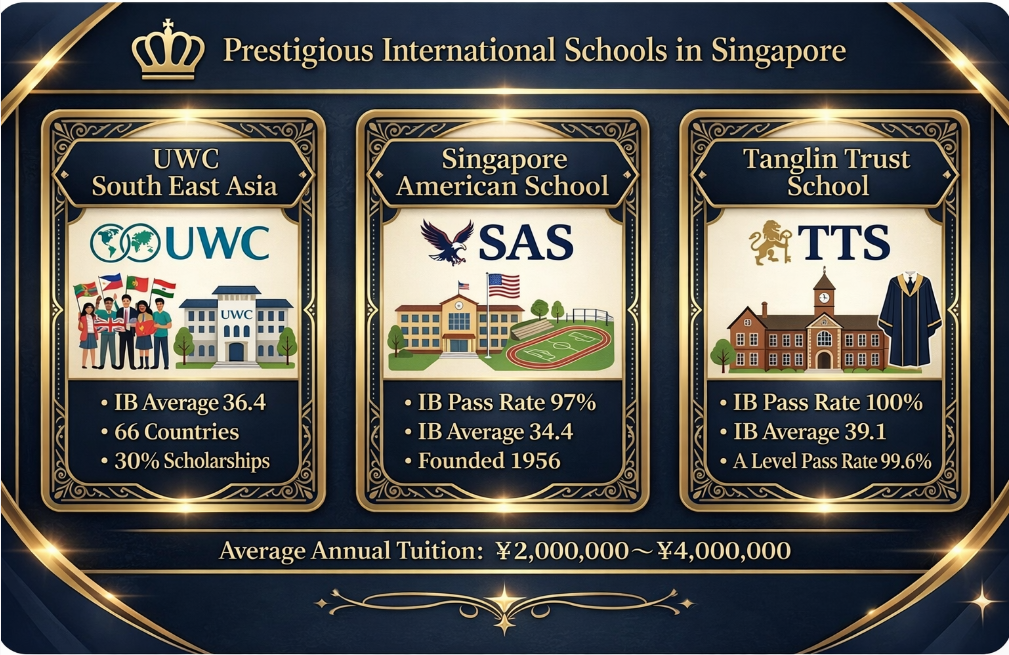
There are many international schools in Singapore, with average tuition fees ranging from 2 million to 4 million yen per year. Enrolling in an international school has its drawbacks, such as the financial burden and difficulty in improving Japanese language skills, but it is recommended for families who want to improve their children’s English and those who want to foster their children’s independence.
There are three international schools in Singapore known as the “Big Three”: UWC South East Asia, Singapore American School (SAS), and Tanglin Trust School, all of which are highly acclaimed internationally.
| ◆ Singapore’s Big Three International Schools① |
| UWC South East Asia |
| ◆ Overview |
| It is the largest international school in the world-renowned UWC group, with a total of 5,500 students across two campuses in Singapore, Dover and East. It implements the International Baccalaureate (IB) program, and students aged 13 to 18 from 66 countries study at the school while living in dormitories. The school has very excellent academic performance, with the average IBDP score for 2025 being 36.4 points, and the top 50 students achieving an average of 44.1 points. 30% of the dormitory residents receive scholarships, allowing them to interact with students from diverse backgrounds and deepen their understanding of others. |
| ◆Singapore’s Big Three International Schools 2 |
| Singapore American School (SAS) |
| ◆ Overview |
| Students receive 12 years of education based on an American curriculum from the age of 3 to 18, and upon graduation they are eligible to receive an American school diploma. Founded in 1956, SAS is Singapore’s oldest international school. It has an excellent academic record, with a 97% pass rate for the International Baccalaureate (IBDP), an average DP score of 34.4 points, and 13% of students achieving a score of 40 points or above. The school is equipped with state-of-the-art teaching facilities, science and technology labs, multiple gyms, and art facilities to meet the needs of a wide range of students. The campus is spacious and surrounded by greenery, cafes, playgrounds, and forests. |
| ◆ Singapore’s Big Three International Schools③ |
| Tanglin Trust school |
| ◆ Overview |
| Founded in 1925, the school provides a British-style education to students aged 3 to 18. Currently, 2,700 students from 54 countries are studying at the school, offering a diverse learning environment. The secondary school uses the British curriculum, the IGCSE program. The Sixth Form, equivalent to the upper level for students aged 16 to 18, offers a curriculum where students can obtain the British A-levels or the International Baccalaureate (IBDP). It is the only school in Singapore where students can obtain A-levels or the IBDP. As the school places emphasis on holistic education, it also places emphasis on sports, arts, music and community service activities in addition to academics. Despite being a prestigious school, the school boasts exceptional academic excellence. The pass rate for the International Baccalaureate (IB) is 100%, with an average score of 39.1 points, significantly higher than the world average of 30.3 points. The pass rate for the British A-levels is 99.6%, with 63% achieving an A* or A grade. Regarding the IGCSE exams taken at the end of secondary school, 61% of students achieved an A* or equivalent, and 80% achieved an A* to A grade. |
Why there are so many British international schools

The reason there are so many British international schools in Singapore is due to the influence of the British colonial period and modern economic and cultural factors that have strengthened its position in international business development.
Historically, Singapore was a British colony. It was under British rule from the early 18th century, and the British education system was introduced. Even after the end of British rule, the country maintained educational and cultural ties, and even today, all languages are taught in English in education settings.
Today, Singapore is an international business hub and the center of the Asian economy, attracting talented people from all over the world. British international schools in Singapore offer high-quality education, and many prestigious British schools have branch campuses in Singapore.
High school international students are looking for career paths and careers after graduation.About Curriculum

Career path after graduating from an international high school:
There are three main career options available to students after completing the high school curriculum at an international school.
- Enter a higher education institution such as a university in Singapore through the foreign student quota
- Return to Japan and take the entrance exams for domestic universities
- Going on to a university or vocational school in another country or region overseas
Admission to universities in Singapore is extremely difficult for foreigners, with emphasis placed on academic performance, English proficiency, and extracurricular activities. For this reason, it is important to start managing your grades and preparing for English qualifications from high school. You will also need to meet detailed admission requirements, such as language proficiency, high school graduation, and completion of a specific period of schooling. Please refer to the website of your desired university for application requirements.
If you are aiming to enter a university in Japan, you should check the entrance exam requirements for returnee students early on and prepare for the exam according to the department you wish to apply to. Depending on the university, returnee students may be required to meet the same academic ability and exam subjects as the general entrance exam, so you will need to plan your studies carefully.
Also, some faculties do not have a quota for returnee students. There are also universities that allow returnee students to take the entrance exam for medical and pharmaceutical faculties, but they only accept a few students, so it is very difficult to get in. One effective way to pass the exam is to attend a preparatory school that offers specialized preparation after taking the exam, and to study for application documents and interviews.
Furthermore, if you are planning to study at a university outside of Singapore, the application method, required documents, and language requirements vary greatly depending on the country and university. Since application periods also differ from those in Japan and Singapore, it is important to research the entrance exam schedule and admission requirements of the university in your desired country early on, and to prepare for standardized academic test scores and English language tests (such as IELTS or TOEFL). Since tuition and living costs can be very high in some countries and regions, it is also important to secure scholarships and funding sources both in Japan and abroad.
International Curriculum

International school curricula vary widely from school to school and are generally not tied to the educational system of the country in which they are located. Many schools follow internationally accredited educational programs and curricula.
Typical examples include the International Baccalaureate (IB), IGCSE, and A-levels. Many schools allow students to take classes according to their desired career path and interests. At the junior high and high school levels, there are also curricula that allow students to specialize in only 3-4 subjects that they wish to study in the future. Choosing a school and curriculum that suits your child’s personality, interests, independence, and ability to balance their studies with non-academic pursuits will help them grow.
In addition, our faculty members are from all over the world. Classes are often conducted primarily in English, but we also offer classes to help students acquire a second language other than Japanese. Students are exposed to a diverse learning environment on a daily basis, and are able to develop not only academic ability but also soft skills such as creativity and logical thinking.
What is the Central Singapore region?
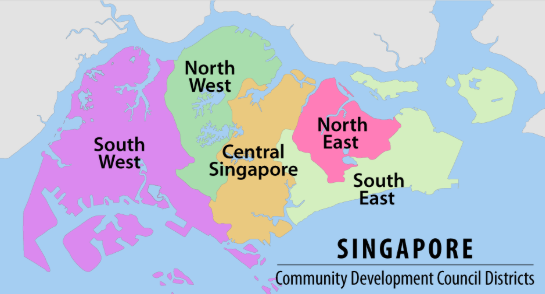
There are no local governments in Singapore, but there are five Community Development Council Districts that are administratively organized.
- Central Singapore Community Development Council
- North East Community Development Council
- North West Community Development Council
- South East Community Development Council
- South West Community Development Council
Meanwhile, independent of government planning, Singapore’s central area is generally referred to as the Central Area or Central Business District (CBD). It is the administrative, commercial, and financial center of Singapore. The Central Area is a central business district and is home to many of Singapore’s iconic landmarks and tourist attractions. There are also many educational institutions and international facilities, making it an ideal place for foreign families to live.
Education system, admission system, and average tuition fees

The Singaporean education system consists of six years of primary school, four to five years of secondary school, two years of junior college, and three to four years of university. Primary school is compulsory, but from secondary school onwards it is basically optional. Also, as there are no school districts, both primary and secondary schools are optional.
For more details, the Ministry of Education, Culture, Sports, Science and Technology has compiled a summary of the Republic of Singapore’s education system in Japanese.HerePlease see here.
There are Japanese elementary schools for Japanese students in Singapore, which cost approximately $9,000 per year. Tuition at international schools is even more expensive. Public schools in Singapore are very difficult for foreigners to get into. The number of schools and the number of students who can be admitted are limited, so priority is given to Singaporean citizens and permanent residents. Foreign students and their families are often only admitted if seats are available.
Public primary school fees are free for Singapore citizens. However, fees for foreigners are divided into monthly fee schedules. They are displayed for Singapore citizens, PR holders, ASEAN foreigners, and non-ASEAN foreigners. See the table below.

Recommended hotels in central SingaporeMe select
Tuition fees are calculated based on the 2025-2026 academic year data, with 1 Singapore dollar = 117.43 yen.
| School Name | Dulwich College Singapore |
| address | 71 Bukit Batok West Ave. 8, Singapore 658966 |
| Available qualifications | IGCSE・IBDP |
| curriculum | British style (general Chinese education from ages 2 to 7) |
| introduction | The school opened its Singapore campus in 2014 and is a coeducational school for students aged 2 to 18. It also has a boarding system for Years 12 and 13 (16 to 18 years old), with a staff to student ratio of 1 to 12 for a total of 300 students. Two hours of self-study time is set aside on weekdays except Fridays.In addition to the 400-year-old tradition of the British main school, we offer an educational environment with students from over 50 nationalities and an English-language school. The school also has excellent facilities and programs for drama, music, dance, sports, etc. |
| Tuition | Year 12-13: Approximately 6.6 million yen |
| Other expenses | can be |
| School Name | Singapore American School |
| address | 40 Woodlands Street 41, Singapore 738547 |
| Available qualifications | American-style graduation qualifications and AP programs |
| curriculum | American style |
| introduction | It is known as one of the top three international schools in Singapore. It opened in Singapore in 1956 and is currently located on a vast, tree-filled campus of approximately 15,000 square meters. It has an enrollment of over 4,000 students aged between 3 and 18. Many of its teachers are from the United States and hold master’s degrees. The school is equipped with specialized, state-of-the-art facilities, including a gymnasium, theater, and tennis courts. |
| Tuition | Year 9-12: Approximately 4.97 million yen |
| Other expenses | can be |
| School Name | United World College of South East Asia – Dover Campus |
| address | 1207 Dover Rd, Level 2, Singapore 139654 |
| Available qualifications | IGCSE・IBDP |
| curriculum | British-style IB curriculum |
| introduction | The school opened in Dover, Singapore in 1971 and currently has 3,000 students from over 100 nationalities. Its campus facilities include a gymnasium, music hall, meeting rooms, and sports facilities. It is a member of the UWC (United World Colleges) and an international educational institution that accepts selected high school students from around the world. In addition to academics, the school places emphasis on creativity, activity, and volunteer activities (CAS). Students from grades 8 to 12 can live in student dormitories, where they can share a life with other talented students from the school. |
| Tuition | G11-G12: Approximately 5.66 million yen |
| Other expenses | can be |
| School Name | Dover Court International School |
| address | 301 Dover Rd, Singapore 139644 |
| Available qualifications | IGCSE・IBDP |
| curriculum | British style |
| introduction | This is a British international school founded in 1972 as a preparatory school. It is a coeducational school that provides education from the age of 3 to Year 3, which is around the age of 18. In addition to the UK’s standard national curriculum for primary education, the school offers IGCSE for secondary education and the IBDP qualification for higher education. |
| Tuition | Year 12-13: Approximately 5.36 million yen |
| Other expenses | can be |
| School Name | Nisai British International Online School |
| Available qualifications | IGCSE and A-level |
| curriculum | British style |
| introduction | Founded in 1996 and headquartered in the UK, it is a historic school accredited by Cambridge as the world’s first fully online international school. Students can obtain international qualifications (IGCSE, A Levels), which are British secondary and higher education certificates. Students can take an international curriculum and receive English language development before moving to Singapore. In addition, the English language development program is available in an environment where Japanese language support is available for those who need it. |
| Tuition | Year 7~9 260,000 yen (per subject)520,000 yen (2 subjects)790,000 yen (3 subjects)1,050,000 yen (4 subjects)1.18 million yen (5 subjects) Year 10-11 (IGCSE) 5 subjects1.3 million yenYear 12-13 (A Level) 3 subjects950,000 yen |
| Other expenses | can be |
Why choose Nisai?

Nisai allows students to take classes regardless of where they live as long as they have an internet connection. Singapore is home to many international schools, but some schools do not offer A Level curriculums or offer poor quality education.
However, once students enroll, it is often difficult to decide to transfer schools. That is why Nisai is chosen, as it allows students to receive a high-quality international education no matter where they are. Here are some reasons why students choose Nisai:
Reason 1: Children who have stopped attending local international schools can continue to learn.
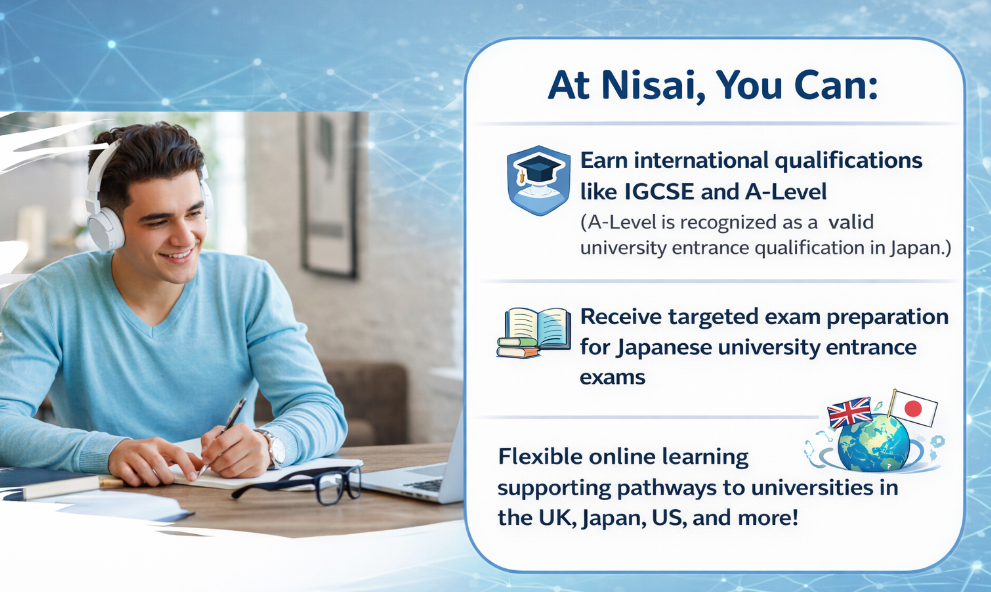
Children who have stopped attending their local international schools often come to Nisai. They are no longer able to attend international schools due to their surrounding environment or friendships.
However, if your parents’ work prevents you from returning to Japan, you can continue your international education by attending Nisai classes at home. Furthermore, you can also obtain international qualifications such as IGCSE and A Level, opening the door to university.
In addition, the Ministry of Education, Culture, Sports, Science and Technology recognizes A Level qualifications as a qualification for admission to universities in Japan, so students can take entrance exams for Japanese universities.We are also affiliated with a domestic preparatory school (JOI), so we can provide domestic exam preparation programs.
Reason 2: It can be used as an after-school program for other international schools, just like a cram school.
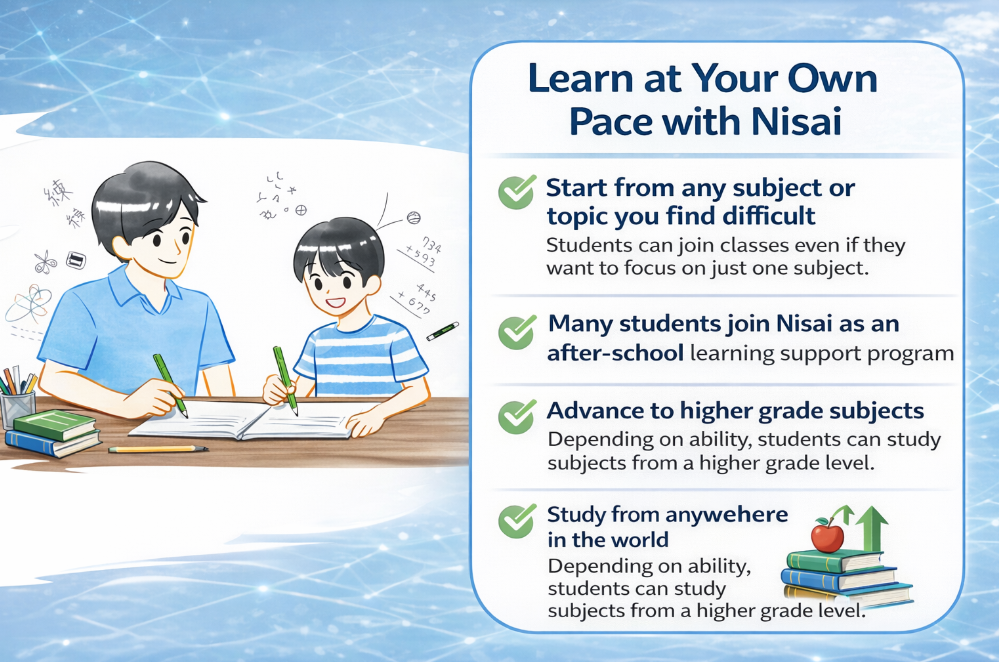
There are probably many students who attend local international schools but feel that they are weak in math or would like to improve their English a little more.
Although Nisai is an international school, students can take classes in just one subject. Many students who live in Singapore enroll in our school as an after-school program, similar to a cram school.
Nisai places students into classes based on ability, so as long as they meet the requirements, they can study subjects one grade higher than those offered at local international schools. Using Nisai for advanced learning and review will have a positive impact on the results of international exams.
Reason 3: You can gain IGCSE and A-Level qualifications, which will enable you to enter universities around the world.

A common issue raised about international schools in Singapore is that there are not many schools that offer IGCSE and A Level curricula of sufficient quality.
Of course, there are schools that offer high-quality A-Level curriculums, but in many cases, they have to hire senior teachers who can teach A-Levels, either from overseas or recruited from other schools, which makes hiring them expensive, and as a result, tuition fees are often high.
Nisai is a fully online international school, so we can hire A-Level teachers overseas. We offer high-quality education at the best possible price. You can take the IGCSE and A-Level curriculum regardless of where you live, and advance to universities around the world.
Summary
Choosing an international school in Central Singapore is an important decision that will affect your child’s future. In this article, we have introduced a wide range of information, from the appeal of Singapore, which boasts world-class educational standards, to the importance of the British curriculum (IGCSE/A-level) and the IB program, as well as the average tuition fees.
While attending a prestigious school offers significant benefits, many students struggle with the change in environment, learning pace, and high costs. This is where online schools like Nisai offer a viable option. By combining the benefits of a classroom-based education with the flexibility of online learning, students can create an educational environment tailored to their individual needs, including measures to address absenteeism and advanced learning in specific subjects. Use this article as a reference to ensure your educational relocation to Singapore is the best possible outcome.